Showing posts with label conservatism. Show all posts

Saturday, September 18, 2010

the marshmallow test

Discipline is the price of freedom.
In the late 1960s, a Stanford psychology professor left a succession of 4-year-olds in a room with a bell and a marshmallow. If they rang the bell, he would come back and they could eat the marshmallow. If, however, they didn't ring the bell and waited for him to come back on his own, they could then have two marshmallows. Film of the kids showed some of them squirming, hiding their eyes, or turning around so that they couldn't see the marshmallow. Some of them ate the marshmallow immediately. Others rang the bell within a minute. About 30% delayed gratification for the full 15 minutes that passed before the researcher returned.

Years later the researcher, Walter Mischel, suspected from stories he had heard about the subjects later in life that there was a relationship between waiting for the second marshmallow and future academic performance. In the 1980s Mischel sent out questionnaires to all the reachable parents, teachers, and academic advisers of the 653 subjects who had participated in the marshmallow experiment, who by then were in high school. He found that the child who could wait fifteen minutes had a SAT score that was, on average, 210 points higher than that of the kid who waited only thirty seconds. Researchers continued to track the subjects into their late 30s and also found that low-delaying adults were more likely to be overweight and more likely to have had problems with drugs.

The implications of what has become known as the "marshmallow test" are significant. As cerebral conservative pundit David Brooks has observed, "[i]f you're a policymaker and you are not talking about core psychological traits such as delayed gratification skills, then you're just dancing around with proxy issues." Yet earlier this week when Brooks lamented the current state of America - "The nation is overconsuming and underinnovating" - he saw many self-described political conservatives as part of the problem: "[i]f Republicans decide that even the smallest tax increases put us on the road to serfdom... the country will careen toward bankruptcy."

Some time ago a commentator responded to my flogging of the HST issue to state that conservative opposition to the HST "has nothing to do with the merits of HST and everything to do with restraining the growth in government." If, with no small indulgence, we were to assume that the HST reform were not revenue neutral but a revenue raiser, the difference between the enacting the reform and not enacting is still not the difference between big government and small but but between big government and big government with a deficit.

The "starve the beast" doctrine has been discredited by the record of self-identified conservative governments in office. Early last year, Andrew Coyne noted that, in Canada,
[Our "conservative" government has put us] on course toward a massive and permanent increase in the size and scope of government: record spending, sky-high borrowing, and—ultimately, inevitably—higher taxes. And all this before the first of the baby boomers have had a chance to retire.
Since 2000, federal spending per Canadian in inflation-adjusted dollars has risen more than a third. The US government has also hardly been the picture of restraint these past ten years, despite Republicans controlling all of the House, Senate, and Presidency for much of the decade.

I'll repeat the point for emphasis: smaller government is realized by smaller government, not lower taxes. Cut taxes, in particular consumption taxes, and all that one has done is move total consumption, private and public, forward in time, the exact opposite of what is, or was, understood to constitute fiscal discipline.

There is, in fact, nothing particularly magical about China's meteoric growth. The country's consumption/investment ratio is massively skewed towards investment relatively to "the West." And the Chinese government understands this, which is why the currency is deliberately undervalued: consumption is more expensive (imported consumer goods cost more) while investment is cheaper (demand for the exports produced by more property, plant, and equipment is higher). A cheap yuan is a transfer from Chinese consumers to Chinese producers, the very business-friendly move that invites the hostility that drives opposition to the GST/HST in Canada and provides popular support for the USA's sky-high corporate tax rates in combination with low or no value-added taxes.

Fortunately, many Americans are alive to the fiscal reality that their government is in. A Deficit Commission has been proposed and designed to be as politically unaccountable as politically possible, since otherwise its recommendations would be watered down if not outright ignored. Republican Senate leader Mitch McConnell (left) was an outspoken proponent of the Conrad-Gregg deficit commission ("We must address the issue of entitlement spending now before it is too late. As I have said many times before, the best way to address the crisis is the Conrad-Gregg proposal...")... until it came time to actually vote on it. McConnell's excuse? "Our problems are not a result of taxing too little, but of spending too much." As Fred Hiatt noted at the time, McConnell "was happy to claim fiscal responsibility while beating up Obama for fiscal recklessness. But when Obama endorsed the idea... and when the commission actually, against all odds, had the wisp of a chance of winning the needed 60 Senate votes - McConnell bailed." The incident is but an example of how efforts to avert the public's gaze from the marshmallow by moving a policy decision a step back from the immediacy of electoral review are typically denounced most loudly and ferociously by populist self-identified conservatives.

Earlier this week the Tea Party was celebrating in Delaware, as Congressman and former Governor Mike Castle lost the Republican Senate nomination to Christine O'Donnell. Charles Krauthammer called Sarah Palin's endorsement of O'Donnell "reckless and irresponsible," while Delaware GOP chairman Tom Ross observed, "I could buy a parrot and train it to say, ‘tax cuts,’ but at the end of the day, it’s still a parrot, not a conservative." EJ Dionne at the Washington Post dubbed Ross' remark his "favorite line of this election season" and I agree: at issue here is a hijacking of the conservative label to reduce it to self-indulgent tax cuts. Back in 2002 and 2003, when a group of influential self-styled conservatives advanced the argument that invading Iraq would usher in an age of peace and harmony to the Middle East, most observers at least recognized this sort of thinking as so far from the traditional "conservative epistemology" - i.e. skepticism about grand claims that state action will bring about a better, more liberal world - that they at least assigned the prefix "neo-" to these "conservatives." Today, a person wanting to buy a Ferrari, and wanting it now, can stand up and demand a tax break on his indulgence (it's invariably a call for a personal tax break as opposed to a break for business in general) and somehow get unqualified trademark rights to "conservative." North American society as whole has flunked the marshmallow test and, in the wake of a fiscal crisis precipitated by debt-financed over-consumption, has responded by looking around for an authority figure to blame, as if the consumer debt friendly policies that exacerbated the problem were not the result of office-holders being over-responsive to the demands of the electorate.

It was not that long ago that Jane Austen's books were back in vogue, as North Americans alienated by the culture of consumption were stirred to feelings of, dare I say it, conservative nostalgia. As Mr Knightley advised, "There is one thing, Emma, which a man can always do, if he chooses, and that is, his duty; not by maneuvering and finessing, but by vigour and resolution." The concept of duty, to entities above and beyond oneself, like the next generation, was once a fundamentally conservative value. It could be again.
Men are free when they are obeying some deep, inward voice of religious belief. Obeying from within. Men are free when they belong to a living, organic, believing community, active in fulfilling some unfulfilled, perhaps unrealised purpose. Not when they are escaping to some wild west. The most unfree souls go west, and shout of freedom. Men are freest when they are most unconscious of freedom. The shout is a rattling of chains, always was.
- DH Lawrence

Sunday, November 22, 2009

the top story of Alberta this decade: the "Fiscal Responsibility Act"

Daveberta is asking what "exciting" event from this first decade of the 21st century might be talked about in Alberta history books 30 years from now. In my view the top story, or more accurately the low point, of the province these past 10 years has been the sorry saga of the mis-named Fiscal Responsibility Act. I'll grant that this particular tale does not come with any exciting moments. If it did, perhaps government fiscal policy, or more precisely the lack thereof, might have captured the interest of the public such that, if the story had occured at all, it would have had a happier ending.

Section 2 of the Fiscal Responsibility Act declared that there would be "no deficits" in Alberta. It also came to require that at least SOME natural resource-related revenue be saved over the course of a cycle. But the provisions of the statute were ultimately ignored every time they actually threatened to constrain government spending. In March 2004, the P"C" government of Alberta amended the Act to raise the point after which resource revenues had to be diverted to the Sustainability Fund from an already high $3.5 billion to $4 billion. It was neither the first nor the last time that the province's financial assets got the short stick. In May of 2005 the constraint was lifted from $4 billion to $4.75 billion, and in May of 2006 up to $5.3 billion.

Colin Busby, an Albertan and a policy analyst at the CD Howe Institute, noted in May of 2008 that Alberta needed "aggressive savings targets" and that “[f]ailure to meet this target will lead to a permanent decline in fiscal capacity this century,” without addressing the fact that the Alberta government had repeatedly proved an unwillngess to abide by even mild savings targets.

In 2009 the charade finally came to something of an end and the Fiscal Responsibility Act was repealed. The Act's flagship clause had specified that "actual expense for a fiscal year shall not exceed actual revenue for that year." While the continual amendments had already made a mockery of the legislation, the government realized that amending the flagship clause to add "plus any amounts allocated from" savings funds would gut the law so blatantly that any further legislation on the point had better be delivered in an entirely new package. Thus was the "Fiscal Responsibility Act, S.A. 2009" born. Dave Hancock said the 2009 moves provided "for a more flexible fiscal framework" without explaining why the old Act was introduced in the first place if "flexibility" is a goal.

The moral of this story is not, or not just, related to the observation of the Director of the U of Alberta Institute of Public Economics that "[h]ad this savings/expenditure constraint remained in place, Alberta's expenditure levels would be about $28 billion annually - not $36 billion currently." It's that Albertans tolerated symbolism over substance for years, either out of a populist predilection to take umbrage only at visceral concerns or out of a lack of enthusiasm for political engagment. Instead of behaving as a trustee or agent of Albertans, the government dealt with savings funds that could have monetized the province's natural resource wealth for the benefit of future generations as if it were the owner.

During his tenure as Liberal leader, Kevin Taft noted the refusal of the P"C" government to "rein in their massive spending" and described them as, in fact, "addicted to spending." "The Tories in Alberta are spending 23 per cent more than the average of other provinces," observed the Liberal. In January of 2008, NDP MLA Ray Martin said, "with all the spending they've been doing, I don't think the budget is going to be pretty." Less than two months later Martin was voted out of the legislature in favour of a PC candidate.

Friday, November 20, 2009

why not propose a cut on investment taxes in isolation?

There are two main reasons why I raised the issue of tax reform in my last post as opposed to just tax cuts. The first is general and strategic while the second is relatively technical and economic.

Fiscal conservatives should not be proposing tax cuts without doing so in tandem with proposals for either how the tax revenue loss can be made up OR specific program spending cuts. While spending cuts is the preferred route, the political reality is that when the government steals from Peter (the taxpayer) to pay Paul, possession is effectively nine tenths of the law meaning trying to claw an "entitlement" back from Paul after he's got it is a far more difficult negotiation (and much of politics is a negotiation) than working towards a structure that doesn't see every last request of Paul indulged in the first place.

Some US Republicans have latched on the Laffer curve to contend that tax cuts pay for themselves, and while that can be true with respect to some capital taxes (capital generally being quite willing to move to the most competitive jurisdiction), it is an overstatement with respect to income taxes ("dynamic scoring" is a more precise way of acknowledging the fact that the new incentive for economic activity post-tax cut will bring SOME of the revenue loss back to the treasury) and pretty much simply misleading when mentioned in the context of a proposed consumption tax cut.

I realize that the "starve the beast" argument exists, but this line was thrown out repeatedly while the GOP ruled the roost in Washington and last time I checked, the belly of the Beltway beast was bigger than ever. Deny the beast its tax revenue and the beast's agent may just go out there and sell debt.

Fiscal conservativism needs to be coupled with some cultural conservatism that appreciates the self-indulgent reality of human nature. Economists sometimes talk about how wages are "downward sticky." When business conditions cycle downwards, wages typically do not go down in tandem with the revenues of employing corporations. The same applies to government spending, such that creating a consensus around program cuts is like herding cats. It follows that a conservative agenda would put a stop to the "step up on the wave peaks" strategy of government expansion by demanding measures that would reduce the volatility of government revenues. Moving towards a flatter tax structure and replacing the taxation of investment returns with a broad-based value added tax would help substantially in this regard, with the clincher being a hedging program.

Advocates who are not prepared to cut programs FIRST and THEN cut taxes should not call themselves fiscal conservatives, because all they are typically doing is calling for deficits and leaving it to the next generation to show true fiscal conservatism. "Starve the beast" is akin to the notion that the best way to get people with massive credit card debt to be fiscally responsible is to cut their salary. The people who think that this would actually work have an optimism about our capacity to act rationally and responsibly that I would not characterize as conservative.

re the second reason, allow me to introduce Alan J. Auerbach. After completing his PhD in economics at Harvard, Auerbach served as a Research Associate at the National Bureau of Economic Research and was Deputy Chief of Staff to a U.S. Joint Committee on Taxation in 1992. He's also a former Chair of the Economics Department at UC Berkeley and is currently Professor of Economics and Law at Berkeley while serving as Director of the Burch Center for Tax Policy and Public Finance. Auerbach has written extensively on taxation, but of relevance here are his observations in the Wall St Journal:

... eliminating capital income taxes would do the opposite, providing a windfall to owners of existing assets. Such a windfall would not only lower progressivity... but would also substantially reduce potential growth effects.
Providing windfalls to existing capital costs lots of revenue. The revenue loss could be made up only by higher taxes on future labor income, which would reduce incentives to work.

The idea here is that if, for example, we just announce that taxes on capital gains are to be eliminated, everyone tax-resident in the jurisdiction would prepare to sell their old capital assets to buyers outside the jurisdiction and consume the proceeds in the consumption tax-free environment that continued following the introduction of the capital gains tax relief. Capital income tax relief thus has to be implemented as a package deal with a consumption tax change.

Auerbach goes on to note that "A consumption tax could increase GDP substantially in the long run."

Sunday, October 25, 2009

conservative fiscal policy and meaning it

While the greatest dangers of the financial crisis may no longer be acute, chronic fiscal challenges remain for most western democracies. Demographic change in particular means that higher levels of saving and investment, both publicly and privately, are necessary if standards of living are going to continue to improve.

What are the options for ensuring this?

The #1 priority in my view is continuing with tax reforms which have been occurring in most jurisdictions (Alberta not being one of them) that encourage the shifting of income from consumption to savings and investment. Even if governments were to start diverting massive amounts of their tax revenue away from consumption by holding the line on services and building up financial and physical assets, tax revenue is only a fraction of a jurisdiction's total public and private income and the private sector's contribution, or lack thereof, to the capital stock, whether it be financial or be physical (property, planet, and equipment) has more impact.

But leaving aside further discussion of these tax reforms for another day and restricting our analysis to the income going to government, how can concerned citizens ensure that their governments are going to be genuinely conservative with the resources allotted to them? Although balanced budget legislation is a possibility and is the first proposal I will review, it is but one of many.

Balanced budget legislation

The two basic drawbacks to "no deficits" legislation are the same two problems we will encounter with a lot of proposals, and that is that 1) the policy deals with a flow instead of a stock and 2) governments can and do ignore such legislation. re point (1), a balanced budget requirement can help in that it sets a target minimum contribution to the stock of capital over a period, namely that it be non-negative (zero or higher). But there is nothing inherently problematic with a negative contribution (withdrawal) from the capital stock over some short period since that does not necessarily mean that the total contributions to and growth of the capital stock over the long term will not be superior to some other jurisdiction which makes a null or a positive contribution over every period. Nonetheless, even if the red/black distinction is ultimately an arbitrary accounting measure, it is still an occasional target, and as the Nudge book I mentioned in an earlier post points out, targets have value. The book's authors note how public urination facilities became a lot less messy when users where given something to aim for. Indeed, one could note that Alberta's current fiscal mess started when government revenues cycled upward and former Alberta premier Ralph Klein lost his target.

Legislation that limits government spending to inflation plus population growth

Again, this would set a target for a periodic flow instead of for the stock that actually matters, but it is a superior target to the balanced budget target since it does not mandate cuts at the worse possible time (during a recession) and mandates less spending proportionate to the economy at the best possible time (when the economy is growing quickly). In an interview with the Canadian Taxpayers Federation in September, then Wildrose Alliance leadership candidate Danielle Smith supported this target but added a proviso that spending also not exceed GDP growth. While this response had the virtues of garnering an A+ grade from the CTF and ensuring that the size of government shrinks relative to the economy not only when real GDP per capita is growing but also when it it shrinking, most economists would consider this additional restriction a mistake. The proviso ultimately undoes the advantage over the balanced budget target by being pro-cyclical: forcing government spending cuts when the economy is shrinking. While left leaning economists like Paul Krugman were demanding massive stimulus spending earlier this year, centrist organizations like the OECD were also urging national governments to pass large stimulus packages, and conservative economists like Greg Mankiw were not opposing the stimulus spending per se but rather acting as the voice for skepticism about how effective the particular proposed stimulus expenditures would be. It was generally recognized that "inaction on sound stimulus is indeed harmful." In almost no case was any prominent economist calling for prompt cuts to government spending. As another writer for the Economist notes, "Faced with growing demands on unemployment assistance, [when] states are forced to cut spending elsewhere... this is procyclical behaviour, which may act to increase unemployment further, forcing additional budget cuts, and so on." When one sets aside ideology for evidence based policy, the evidence from the Great Depression suggests that cutting back government expenditure at the same time that consumer expenditure is in decline creates the grave risk of an economic death spiral. Adding the GDP proviso is unnecessary, because when real GDP per capita growth (GDP growth less inflation and population growth) is negative that is by definition temporary (if real GDP per capita is in permanent decline the whole point of economics would be defeated). In other words, the size of government is also a stock, such that whether it is shrunk in every accounting time period is not ultimately germane to the real objective. Real GDP per capita will increase over the long term, meaning that over the long term the size of government relative to the economy will be reduced without adding a further constraining proviso to the inflation + population growth limit. I would also argue that the GDP deflator should be used in the place of "inflation" (I've equated the two in my discussion here) but that's a technical objection.

Legislation that requires a proportion of revenues (often a subset such as supposedly "non-core" revenues, e.g. natural resource royalties) be saved or invested

This target is part way between the above two targets, since while it shares with the inflation + population growth limit the advantage of not requiring cuts during a recession, under this target both spending and saving would grow in lockstep during boom times without an upper limit such that spending growth could still be very high. Again, when at economy is peaking an expansionary fiscal policy just encourages increased prices, and the increase in government purchases shifts resources away the private sector, a phenomenon known as "crowding out."

Combining a capital stock associated limit on spending (excluding infrastructure spending) with mandated revenue hedging

This proposal is my favourite since it has what I believe is an enormous advantage over the other proposals, namely, that governments will not be able to ignore the target because they simply will not have the money to violate the target. In the Alberta of 2007, for example, the government's positions in currency and energy futures would have been marked to market and the government thereby required to plow its windfall royalty income into international hedging markets. In 2009, we would see billions coming back to the province from these same markets. I would exclude infrastructure spending since this constitutes physical investment. While it is possible to invest poorly, and indeed the Alberta government has a consistent pattern of buying high and selling low by choosing to "buy" infrastructure assets when the market is at a top, it is still investment, and by mandating hedging the government's discretion to "buy high" will limited. Stock associated limits to spending could be akin to the covenants that bondholders demand from issuing corporations with respect to the health of their balance sheets as opposed to just their income sheets, or they could be the sort of constraints relatively sophisticated regulators apply to financial institutions (see Basel II), e.g. limits informed by Value at Risk modeling.

"Stock" associated limits to spending discretion may prove too complex to constitute a political campaign plank relative to a readily understandable limit like no more than inflation plus population growth, but hedging, while complex to explain in detail, is quite straightforward as a concept and the general idea that the citizens of Alberta are bondholders and shareholders in their government is also a fairly simple one. Should a politician's pay be tied to the size of the Heritage Fund à la a private sector executive's? The corporate analogy is worthy of consideration, not least because it could ensure more professional and competitiveness-oriented management.

I believe that this is THE challenge of our age. Do we leave something behind for the next generation or not? If we are serious we will not just talk about how we intend to start showing some willpower with respect to the cookie jar, we will explain how it will be placed outside of our reach.

UPDATE October 26:

The Wall St Journal notes that after posting a $1.4 trillion deficit in 2009, the US House of Representatives is now moving on spending bills that would grow domestic programs by a further 12.1% in 2010. The WSJ also observes that "real family incomes fell by 3.6% last year" and the point I wished to make about spending growth that is higher than GDP growth but no higher than inflation plus population growth is that this would or could maintain government services for consumers whose real incomes are falling. Although government would grow relative to the economy during this period of decline, there would no increase in real government services per person and the proportionate growth in government would be temporary. If government services are to be cut back as opposed to just kept from growing further, they should be cut back when real incomes are rising.

But I may have been imprudent to take issue with Danielle Smith in this context. As Don Martin observes in a revealing National Post column, "Ms. Smith was on an Ottawa talk show with me this week and, even though it was still pre-dawn darkness in Calgary, she batted every question out of the park..." The contrast with Sarah Palin being interviewed by Katie Couric (to take one of the most infamous episodes) could not be sharper. The takeaway fact with her is that she is one of the sharpest policy minds in politics, yet getting that most elementary of messages through the North American noise machine will be enough of a challenge without bothering with nuance. This morning Danielle ended up on the website of the Charleston (South Carolina) Daily Mail as "the Sarah Palin of Canada." How does this end up in the mainstream media? The Charleston Daily Mail writer uses the Canadian media as cover:
I figure the Canwest News Service knows something about Canada and the news service has declared Danielle Smith, the new leader of Alberta’s Wildrose Alliance, the Sarah Palin of Canada.
In fact the Vancouver Province writer who is cited here put a big question mark at the end of its "A Sarah Palin for Canada" headline, not a period. But with respect to which MSM outlet surrendered its gatekeeper role to the commercial appeal of another "Sarah Palin" headline that would indeed be Canwest since it was their writer who made a story out of a blogpost by 22 year old Colorado Springs blogger Adam Brickley. The meme was then picked up by Global TV Edmonton and the Examiner.

Friday, October 9, 2009

"Output" democracy and paternalistic libertarianism

The "Ideas" section of Wednesday's Edmonton Journal featured a piece by Dr Bob Ascah titled "Smoothing Out the Boom and Bust." Ascah is currently director of the Institute for Public Economics at the University of Alberta. He notes that in 1982 "resource revenue was nearly four times the take from personal income taxes." Furthermore, "[r]esource revenue represented 2½ times the cost of health care and twice education expenditures." According to Ascah, in 1982 Premier Lougheed diverted resource revenue that would have gone into the Heritage Fund into general spending, and
Had the investment income been retained by the fund, the size of the Heritage Fund today would be $80 billion, compared with its current value of $13.8 billion
Ascah then moves forward in time to the turn of the millennium and rapidly increasing resource revenue to consider the "staggering" opportunity cost of this decade's spending spree. Behind these observations is Ascah's thesis that the government's fiscal policy has been aggravating the cycle instead of dampening it. He notes that "As private investment peaks, public investment is also peaking causing a "crowding out" effect resulting in higher construction costs in both the private and public sector." This is another excellent point that I had hoped to raise in the context of the affordable housing issue during last year's election.

In a note to another Wildroser this week I raised the possibility of the party adopting as part of its platform a major tax reform that would tax privilege savings and investment over consumption. "It wouldn't pass a referendum," was a response.

Coughing up policy for referendum is certainly one approach. There is another approach, however, the first step of which involves throwing a policy plank out before the media. The media then takes it before some "expert", who gives it the thumbs up or thumbs down. The media subsequently reports this verdict, and if it was thumbs up, the public concludes that the party is not just a mob. Note that under this approach, the party actually has a need for policy wonks as opposed to just pollsters and focus group organizers. The wonks' job would be to develop policy that can carry a narrative and win arguments come campaign time. This is policy that is typically NOT initially popular.

Dirk Kurbjuweit, writing for Der Spiegel, notes that
The scoundrels in Brussels have sold the European people a lot of things: a single market, the euro, the lifting of many border controls and, most recently, a binding global climate policy. These have all been good things, and they have helped make Europe an eminently livable continent. Despite the many dull moments and emotions that have been negative at best, the end result has been laudable.
Most of these improvements would have been held up, if not outright prevented, by referendums.

Yesterday, the frontpage of the Edmonton Journal was "Wildrose Support Blooms." The story described how a survey by U of Lethbridge political scientist Faron Ellis found Wildrose Alliance support in the province to be comparable to or even higher than that of the Alberta Liberals. Had this come out prior to the Glenmore by-election, I would have thought it a bombshell, but post-Glenmore, I didn't think there was much news here apart from what was in the cross-tabs.

Some of the crosstabs surprised and concerned me, since they seemed to support Ellis' contention that "One of the problems this party’s going to have is, they’re going to go down the populist road."

After the Irish rejected the Lisbon Treaty last year, one member of the European Parliament described the "No" movement as "a toxic cocktail of anti-globalisers, neocons, the clergy and Trotskyists."

A toxic cocktail of another flavour is what the Wildrose Alliance will become if the party continues down this "road."

It doesn't have to be this way. As a number of European observers have noted, the classical model of democratic legitimization from the bottom up (from the citizen to the state) is an obstacle to modernization not an engine of it. Wolfgang Hoffmann-Riem's notion of "no longer securing legitimization solely through institutions and processes, but also through results" is an example of
the theory of so-called "output" democracy, in which more weight is placed on the persuasive power of results than legitimization through "input" from democratic opinion-shaping processes within the population.

Wildrose support bloomed in the late summer of 2009 in large part because a result of consuming our natural resource revenues instead of saving them was the fueling of a pro-cyclical fiscal policy that aggravated the province's recession. We are not going to unwind this dynamic by submitting the painful components of the necessary adjustment to the public in referenda. California has already attempted this with "epic fail" results. Am I opposed to the self-determination of individual citizens? To an extent, yes: I've long believed that libertarianism is an incomplete and possibly naive philosophy. As David Brooks has noted, we have a crisis of economic morality, and the solution will ultimately involve making men moral. At the root of our problems is collective self-indulgence on a mass scale at the expense of future generations (of not only humans but animals and plants).

Harvard Law professor and Obama advisor Cass Sunstein partnered with economist Richard Thaler to write Nudge, a book whose wisdom about the value of building a "choice architecture" will be lost if all everyone can see (and object to) is the paternalistic element in Sunstein and Thaler's notion of "paternalistic libertarianism."

Sunday, October 4, 2009

National Affairs launched

In 1965 Irving Kristol and Daniel Bell founded The Public Interest, a higher brow public policy journal for the conservative American. In the 21st century, however, the magazine declined and finally stopped publishing in 2005. Fortunately, a successor has sprung up.

In 2008, Republican representatives in the House hailing from New England became extinct, and it's commonly thought that an intellectual revival would save the Republican party from being reduced to a Southern rump. But as this graph by Sean Trende shows, the GOP's decline is not just a recent (and therefore reversible) phenomenon:


Thursday, October 1, 2009

open letter to Alberta evangelicals

Perhaps you frequent one of Beulah Alliance's 3 weekend services in Edmonton's west end. Perhaps you travel even further west on Sunday mornings and are a member of West Meadows Baptist on 199 st. Maybe you head to 167 ave to worship with your Pentecostal brethren at North Pointe, Edmonton's newest suburban megachurch. Do you attend First Alliance in Calgary's southeast? Perhaps you are a Briercrest graduate like I am, or an alumnus of Ambrose in Calgary or one of its predecessors (Canadian Nazarene College or the C&MA affiliated Canadian Bible College). You might alternatively have a connection to Prairie in Three Hills, Canada's oldest bible institute, or Taylor in Edmonton.

You might be an evangelical! Some will say you might be a redneck as well, but if these critics attended a service at Beulah they would see the bright, welcoming faces of contemporary suburban Albertans.

Whatever your denomination background, evangelicals share something in common, and that's a belief in the power and necessity of personal regeneration. Why is regeneration necessary? Because we are born in the flesh, and the flesh isn't interested in what is noble, inspiring, and righteous. The flesh is interested in selfish indulgence. A lot of secular people reject this contention, maintaining that we are born tabula rasa. Society, according these secularists, need only educate the young in how to reason and they will flower into caring, responsible, industrious citizens. The experience of innumerable generations suggests otherwise. Remove the influence of the church, parents, and tradition from the raising of the next generation and one does not create some enduring vacuum which liberates the young to self-determine. The vacuum is instead filled with other influences, namely, peer pressure and pop culture. Social liberals like to think that every time they have undermined or destabilized a norm, some emancipatory effect follows, when in reality we become enslaved to our own baser instincts. This is why the "culture wars" matter. "Live and let live" isn't a call for a truce but a call to surrender to "entitlementia" and, ultimately, the social breakdown concomitant with anomie.

In fact, I've oversimplified with "live and let live": one not only can but should "live and let live" when it comes to matters of economy and administration. This, the legal world, is the arena in which the final authority of human reason is recognized by all parties. Where one cannot "live and let live" is in the "life world" - here, no one "lives and let lives" since every life has to be lived on the basis of some fundamental metaphysical assumptions. In this arena rational argument is of limited utility: Alvin Plantinga's notion of "foundational knowledge" is an argument of sorts, but in many respects it is an argument against argument. I could develop this approach further by borrowing from the postmodern critique of modernism but to express the point simply would be to note that in practice, most people come to a weltanschauung which appreciates concepts like sanctity through a transformation that is deeper than the mind: it goes to the soul (personal regeneration!). Trying to argue someone into faith on the micro level is unlikely to be productive, as is trying to use the political process to lobby people into adopting a Christian perspective. It is more effective to use the political process to create the public space that allows one to transform lives on the particular, private level. This is where living one's faith becomes the most effective tool for evangelism. Get political in order to be able to get unpolitical.

This idea of two worlds, one instrumental and governed by commonly recognized principles of rational efficiency, the other personal and subjective, is not original. Lest I misconstrue the sociologist Daniel Bell, I will defer to Jürgen Habermas' summary of Bell's views:
In his book, The Cultural Contradictions of Capitalism, Bell argues that the crises of the developed societies of the West are to be traced back to a split between culture and society. Modernist culture has come to penetrate the values of everyday life; the life-world is infected by modernism. Because of the forces of modernism, the principle of unlimited self-realization, the demand for authentic self-experience and the subjectivism of a hyperstimulated sensity have come to be dominant. This temperament unleashes hedonistic motives irreconcilable with the discipline of professional life in society, Bell says. Moreover, modernist culture is altogether incompatible with the moral basis of a purposive rational conduct of life. In this manner, Bell places the burden of responsibility for the dissolution of the Protestant ethic (a phenomenon which has already disturbed Max Weber), on the "adversary culture." Culture, in its modern form, stirs up hatred against the conventions and virtues of an everyday life, which has become rationalized under the pressures of economic and administrative imperatives.

Lifestyle evangelism works. Political evangelism, however, often doesn't and when it does make a difference it can be for the worse.

James Dobson's Focus on the Family group has been a great service for both Canadian and American evangelicals. But Dr Dobson's Family Research Council, which is more explicitly designed to be a vehicle for political activism, has been a lightning rod for controversy. When President Bush nominated Harriet Miers for the United States Supreme Court, Dobson gave his stamp of approval (according to some reports, after Karl Rove gave him private assurances about Miers). What Dobson was missing, however, was allies. One could argue that he applied a litmus test without appreciating the fact that a candidate for high office requires much more. The libertarian intelligentsia within the conservative movement rebelled because of Miers' limited abilities in the realm of reasoned argument, and her nomination was withdrawn. To go back to the Habermas quote, what one might call "economic and administrative imperatives", or perhaps just the sound administration of justice and good government, demanded that Miers not stand for nomination. The fact that there was no necessary conflict between social conservatives and libertarians was demonstrated when the subsequent nomination of John Roberts got the process right.

Contrast this episode with Rick Warren's sure footedness on the national stage. Pastor Warren needs no introduction to evangelicals; The Purpose Driven Life is one of the best selling non-fiction books of all time, even if (too) much of unchurched community has never even heard of it. During last year's Presidential campaign Warren hosted John McCain and Barack Obama in a forum at the Saddleback Church he pastors. Warren didn't tell these men what he thought they should do, he rather asked them questions. After the event, a secular liberal pundit said
The one sure winner was Rick Warren, who overnight changed the face of evangelicals in this country from the cartoon caricature of rigid, right-wing fundamentalists to one of open-minded, intelligent, concerned citizens.

In Alberta, recent political events have created the opportunity to either reinforce that "cartoon caricature" or dispel it. The government of Ed Stelmach has made a show out of addressing the concerns of social conservatives, but has in fact aggravated the "adversary culture." Section 9 of Bill 44 does not push the state out of the church's sphere. It rather expands the state, and then makes a show out of leasing the state's new territory to the church. The powers of the human rights tribunals are broadened by this bill. If it is families 1, teachers 0 this game, it could easily be families 0 next game in a series the teachers didn't ask for. Most of the more prominent members of the Wildrose Alliance Party have not been caught up in the red herring of section 9 because they have focused on section 3 which authorizes the state to adjudicate the dialogue of the church (amongst others). If some speech should offend secular humanist sensibilities by, say, defending social norms and thereby implying that some identifiable group is deviant, the Stelmach government reserves the right to see the speaker investigated and censured.

As a party that understands the importance of separation between the church and the state, the Wildrose Alliance will create opportunities for evangelicals to get a fair hearing and accordingly be recognized as the "open-minded, intelligent, concerned citizens" evangelicals are. The party, which sent a shock wave through the provincial political establishment when it won a byelection on September 14, already has more members than any other opposition party. A leadership race is underway and there is a candidate in the race who can speak authoritatively to "economic and administrative" issues. She not only does not clash with "Modernist culture", she is fully in tune with it; but has firm convictions about the limits of its ambit. She would be no help to social conservatives encroaching on a minimal state, but would be an invaluable ally in defending against an encroaching state. If two roads, one involving the retreat of the state and the other involving the advance of the church, would both keep us moving in the direction of our destination, shouldn't we take the way that is passable? However much the metaphysics of secular humanism may inform Danielle Smith's personal "life world", she is not on a mission to bring Voltaire's godless Enlightenment to the "life world" of others, she's rather on a mission to bring enlightened government to government.

If you haven't yet become a member of the Wildrose Alliance, I would urge you to do so by visiting daniellesmith.ca either today (October 1) or tomorrow, signing up, and then casting your vote for the same candidate that astute social conservatives like Link Byfield support:

Wednesday, September 30, 2009

Brooks, Habermas and conservatism

Lately I had been second guessing my verdict of earlier this year that New York Times writer and PBS Newshour talking head David Brooks is "my favourite pundit." He's just been too wimpy. Although he may be a conservative, his whole style screams liberal. His being molested by a US Senator wouldn't be such a headshaker if it didn't fit his personality so well. Man up, Brooksie! Some guy is violating your personal space? Tell him to lay off and if he won't then start shoving! As David Warren of the Ottawa Citizen has noted, Brooks once retracted the views he presented in a column after the White House called him and told him to get back in line. Do you think they could muscle Krauthammer like that? I think not!

But Brooks has earned his keep with his Sept 28 opinion piece about the need for "economic morality":
Over the past few years... there clearly has been an erosion in the country's financial values. This erosion has happened at a time when the country's cultural monitors were busy with other things. They were off fighting a culture war about prayer in schools, "Piss Christ" and the theory of evolution...
In 1960, Americans' personal debt amounted to about 55 percent of national income. By 2007, Americans' personal debt had surged to 133 percent of national income....
If there is to be a correction, it will require a moral and cultural movement.
Our current cultural politics are organized by the obsolete culture war, which has put secular liberals on one side and religious conservatives on the other....
It will have to take on what you might call the lobbyist ethos... It will have to take on the self-indulgent popular demand for low taxes and high spending.
A crusade for economic self-restraint would have to rearrange the current alliances and embrace policies like energy taxes and spending cuts that are now deemed politically impossible. But this sort of moral revival is what the country actually needs.

What I find compelling about Brooks' analysis is that he criticizes what the "cultural monitors" have been obsessing over but does so from a conservative as opposed to a liberal or libertarian perspective. I am not a libertarian. Never have been. When I was a young adult and at the stage where I might have become libertarian I was exposed to Postmodern thinkers and subsequently decided to reject libertarianism as a Modern and therefore philosophically untenable ideology. But that doesn't mean that the rationalism that drives libertarianism at its purest isn't of tremendous practical value within a circumscribed sphere. I've championed communally conscious or responsible libertarianism which rejects the usual "culture war" as obsolete because with luck my fellow conservatives will be convinced that if we follow the Glenn Becks of the world down the road they are on we will just be barking louder up the wrong tree. I say "communally conscious" libertarianism because the retail politics that have been labelled libertarian in the United States have routinely been infected with the "lobbyist ethos" Brooks rightly indicts. Regular readers of this blog would note that Brooks' call for "energy taxes and spending cuts" is a prescription I've been writing out for anyone interested in which medicine I think we need to swallow.

My one reservation with Brooks' opinion piece is that he seems to suggest that "religious conservatives" should give up one battle in favour of taking up another one without really explaining what is different about the second battle aside from the implied suggestion that the second battle is currently being lost via neglect. There are, in fact, sound reasons for why the first battle is misguided beyond just questions of tactics. For this, one may turn to Jürgen Habermas' essay "Modernity versus Postmodernity" where Habermas describes conservatives who
welcome the development of modern science, as long as this only goes beyond its sphere to carry forward technical progress, capitalist growth and rational administration. Moreover, they recommend a politics of defusing the explosive content of cultural modernity.
According to one thesis, science, when properly understood, has become irrevocably meaningless for the orientation of the life-world. A further thesis is that politics must be kept as far aloof as possible from the demands of moral-practical justification.

Note that politics "must be kept as far aloof as possible" from what I would call the hot button social issues. Why? Because it's the exact opposite of "defusing": it's inflaming. It creates a take-no-prisoners show down with Modernity when Modernity ought to be encouraged to flower within its circumscribed sphere. I, for one, champion the Economist on a regular basis but that's because it addresses "technical progress, capitalist growth and rational administration." When it infects the "life world," that is when to pick a fight. I am not saying religious conservatives should not be fighting the battles that have been fought per se. I am saying that these should be battles for souls and need to be de-politicized. De-politicized means reserved for the "life world" and separate from the world of "administration." Rendering unto Caesar what is Caesar's means preventing abortions through private counselling not public lobbying.

But doesn't Brooks venture into the public arena when he calls for an "economic morality"? Yes, he does. But the difference here is that "the enemy" does not have to change his or her fundamental metaphysical presumptions to come around. Athiests can appreciate the need for an "economic morality" by considering the social science evidence and reasoned appeals to shared self-interests. They can't appreciate the need to ban abortion if their metaphysics doesn't recognize a notion of sanctity. They have to be won over on that issue by personal regeneration, not political lobbying. In the economic, or more precisely the instrumental, sphere, however, conservatives can go on the offensive and win with libertarian allies. Outside this sphere, one should battle privately not publicly because publicly it will be a continual defensive action (the currency of the public or political battle is language and reason and conservatives believe the efficacy of these tools is limited because our worldview was ultimately arrived at via irrational, nonverbal experience). Not only is the prospect of winning the political battle over, say, abortion more unlikely with every decade that Modernism advances, making a political fight out of it raises the stakes, putting everything at risk, because it suggests that co-existence is impossible. If we indicate that we cannot live in a world in which they do not adopt our metaphysics, they are going to resolve to eliminate the threat by eliminating us. In fact, co-existence is entirely possible if Modernism/Rationalism/Instrumentalism is contained within its appropriate field: separate "life worlds", common political worlds. Libertarians will be our allies in a circumscribed political world and will even help protect our separated "life worlds" but first we have to recognize that arguments with theistic assumptions are not going to work in the political sphere. That concession in no way implies that they do not carry the day in the private sphere of concrete personal experience.

Tuesday, May 26, 2009

Obama nominates Sonia Sotomayor for US Supreme Court

We need somebody who's got the heart, the empathy, to recognize what it's like to be a young teenage mom. The empathy to understand what it's like to be poor, or African-American, or gay, or disabled, or old. And that's the criteria by which I'm going to be selecting my judges.

Given how Barack Obama's remarks, above, contrast with the picture of blindfolded Justice, one might think the White House would have some concern that the "empathy criterion" might be wielded as a talking point against his judicial nominees. After all, what does Obama expect his judge to do with information about a litigant's particulars if not to put a thumb on the scale in favour of the litigant who is one of Obama's enumerated groups? Yet apparently the White House is running with the idea as a talking point FOR Obama's first Supreme Court nominee.

Combining this with Sotomayor's remarks in 2001 about how she "would hope that a wise Latina woman with the richness of her experiences would more often than not reach a better conclusion than a white male", should one start preparing for judicial bias against white males that is sanctioned at the highest level? While there is cause for concern here, I believe the concern applies elsewhere. First of all, a full reading of Sotomayor's Berkeley speech indicates that she does not believe the idea of departicularized adjudication should be rejected but rather that it is impossible to implement:
our gender and national origins may and will make a difference in our judging. Justice [Sandra Day] O'Connor has often been cited as saying that a wise old man and wise old woman will reach the same conclusion in deciding cases.... I am... not so sure that I agree with the statement.
This is of note because it is consistent with the views of communitarians, e.g.
[impartialist morality] assume[s] an abstract and artificial - perhaps even an impossible - stance, that of a rational being as such, responding to the requirements of morality not qua peasant or farmer or quarterback, but qua rational agent who has abstracted him or herself from all social particularity.
- Alasdair MacIntyre, Is Patriotism a Virtue?
This is important because the idea that our moral selves are "embedded" is critical for cultural conservatives. I don't have the time to explain why in detail, but without it one has a libertarian worldview, not a conservative one. The bottom line is that I do not think conservative critics should be raising the alarm about potential bias on Sotomayor's part against business or white males too loudly lest they create future consistency problems for themselves when defending something like patriotism. Accept that she's a Latina and therefore will have a Latina's perspective to at least some degree.

The best and most damning criticism, I believe, advances not from the idea that justice flows only from the departicularized perspective but from the idea that a judicial temperament and judicial ability flows form the process of departicularizing oneself. This is a subtle but key distinction. It is the difference between making a metaphysical claim and making a claim about process. The problem is not that Sotomayor won't employ abstraction, but that she can't. Where is the rigorous reasoning in her Ricci decision? Why is Obama playing up her life story and downplaying the importance of legal abstraction? It is not just the far right that sees a problem here.

Obama is not going to appoint a conservative. That is to be expected. But it serves the interests of both the left and right better to appoint the person with the greatest abstract ability. Cass Sunstein is a legal lefty. But appointing an ideologue like him would serve the interests of an ideologically divided country better given his intellectual abilities. Consider the talking points in the White House memo:
- as the President has made clear, upholding those constitutional values requires more than just the intellectual ability to apply a legal rule to a set of facts. It requires a common sense understanding of how laws affect the daily realities of people’s lives.
- Judge Sotomayor ... understands that upholding the rule of law means going beyond legal theory to ensure consistent, fair, common-sense application of the law to real-world facts.

A further downgrading of the value of "theory" is, in fact, the last thing America and the world should be considering a personal asset apart from the personal, private field. It is all too easy to sell policies to the public when the consequences are right there before one's eyes. It is far too hard to sell policies when the consequences are distance in time and space. Appreciating those consequences requires the ability to think abstractly. The idea that people who are skeptical of things like restricting EI eligibility simply lack "empathy" is a lefty trope; the skeptics are typically just as sympathetic but appreciate the abstract arguments that reveal how many well-intentioned policies typically backfire.

Friday, April 17, 2009

crisis for capitalism = renaissance for left?

I have not written much on the financial crisis since I have been on the road and still am (currently in Chile). But I have a few moments today...

I do suspect there will be a serious revisiting of the idea of freedom of contract. But I do not think that it will be the leftist critique that cuts much ice. The left has often opposed freedom of contract on the grounds that contracting power is not equal. Unions, for example, may operate just like cartels in that they try to act as a monopoly supplier for their good or service (in this case, labour), but anti-competitive behaviour is OK if the victim is a corporate producer instead of an individual consumer (I could note the fact that, at the end of the day, it is still individual consumers who pay for the dead weight loss but that's another column). But at the root of the current crisis is credit being extended to poor individuals on terms that no one can say was too favourable to the corporate creditor. In fact, the terms were not favourable enough to those corporate creditors. Government policy that encouraged this flow of credit (including, but not limited to, mortgage deductibility) for no other discernible reason than creating more home owners (something that has no necessary relation with raising living standards) exacerbated the problem.

People can, and are, wagging the finger at the bankers. But the leftist critique has a hard time explaining how the bankers are to blame when it is the banks that are taking the hit and the borrowers who are washing their hands of unpaid debts. Sure, some banking executives made out like bandits, perversely, but in all of these cases it is not the borrower that was left holding the big but other capitalists, like the high rollers who put money into exposed hedge funds. The borrower is really only suffering because of the grief of the capitalists has "trickled down".

One can speak of "regulation", which is popularly conceived of as opposed to freedom of contract and therefore something on the "left" agenda, but in fact regulation is not necessarily left but anti-libertarian. Conservativism, as distinct from libertarianism, has always been suspicious of free wheeling capitalism. What conservatives approve of is competitiveness, something the left generally opposes (see my observations about labour supply cartels). A competitive character is a strong character. It is something in the blood. Freedom of contract, on the other hand, is an abstraction. And make no mistake, excessive abstraction is the root cause of the current crisis, when viewing from the most philosophical level.

A lot of regulations serve the leftist agenda of protecting favoured groups from competition. We do not need any more of that. But we could use more regulation that protects people from themselves. People have an inordinate capacity to create layers of abstraction that while theoretically designed to raise one's perspective from the concrete and immediate, often end up looping back to themselves in obscure ways such that one's perception is clouded by a false confidence. I have often preferred literature to formal philosophy because the former is more rooted (as an aside, I do not think the fact the Anglosphere is fertile ground to both analytical philosophy and exotic financial derivatives a coincidence). As novelist Joseph Conrad, very much a cultural conservative in temperament, wrote

Hang ideas! They are tramps, vagabonds, knocking at the back-door of your mind, each taking a little of your substance, each carrying away some crumb of that belief in a few simple notions you must cling to if you want to live decently and would like to die easy!


But it took two to tango here. Whereas the financiers blinded themselves via too much modeling and too little sense, the borrowers freely contracted with the bankers in order to satisfy their own consumption interests.

If I am getting too metaphysical here, it is because the continual search for an economic (or "abstract") explanation and/or solution is itself not going to be very satisfying if abstract models are themselves part of the problem. Economics does have a model for freedom of contract problems, namely, externalities (and externalities call for anti-libertarian policies). But this was not really a problem like a consumer and a producer freely contracting to dump the pollution associated with production on a third party. The categories are not so rigid. To a large degree, the third party here was the financiers themselves. It was the layers of abstraction that facilitated the inability (or unwillingness) to see that the music could stop and that it was themselves who could be left without a chair.

Wednesday, March 4, 2009

the Singapore "experiment"

I'm currently in Malaysia, but will be returning to Alberta at the end of the month for at least a few days.

I spent close to 2 weeks in Singapore last month, and continued to be impressed by the quality of life there. Meanwhile, I note that stories of crime in Vancouver and Toronto have been getting more press. As a general rule, when it comes to drawing inferences about society, one should stick to statistics because the media generally sensationalizes crime. But a comment on Vancouver's gang wars struck me as nonetheless compelling: "The Vancouver "experiment" in tolerance has proven the coexistence of degradation and lawlessness."
It is compelling because, according to the Economist, "the idea that graffti-spraying and other forms of low-level delinquency promote further bad behaviour has now been tested experimentally". In other words, the social illiberalism of a place like Singapore has an empirical rationale for its policies. Order has its own positive feedback, leading to a upward spiral in terms of security and qualify of life.

This is another element which libertarianism is weak on: the idea of "low-level delinquency". For libertarianism, the world is much more cut and dried, with autonomous, rational individuals. For better or worse, in the real world is quite irrational and individual decision making far from autonomous.

Tuesday, February 24, 2009

why I'm not an unqualified libertarian, part II

David Brooks' latest NYT column would be mandatory background reading should I have another post on this subject, and am linking to it now for ready reference.

Sunday, August 24, 2008

the necessary enigma of Pat Buchanan

In a world where the cachet of "alternative" is largely reserved for the left, Pat Buchanan's boat rocking dissents are a welcome challenge to conventional wisdom from the right.

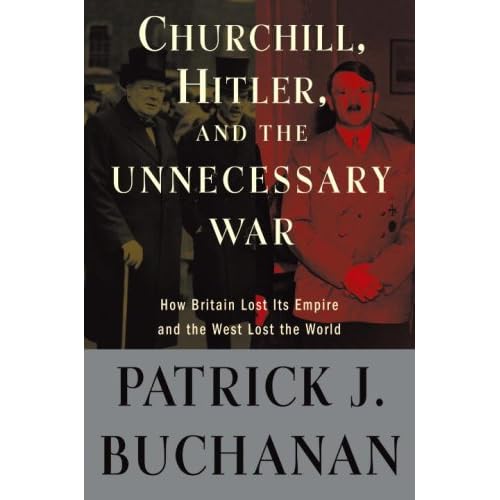
I'll confess that I haven't read Churchill, Hitler, and "The Unnecessary War": How Britain Lost Its Empire and the West Lost the World. However, the appearance of this book should not be the least bit surprising to followers of Buchanan's thinking in recent years and his description of the world wars as a "Civil War of the West". Paleo-conservatism is not politically viable today next to the alternatives of left-liberalism and neo-conservatism and that is largely because elements of paleo-conservatism reject the universalization of identity in favour of a particularistic "blood and the soil" narrative and that sort of thinking is seen in many corners as the intellectual root to the horrific excesses of Nazism. Buchanan's anxiety over immigration was the accepted wisdom prior to World War II, yet after it became a political third rail. It's only natural that Buchanan is going to lament the event that empowered cultural relativism and pushed his identity politics to the fringe.

Christopher Hitchens' critique of the book, and his conclusion that it not only "stinks" but has "sinister" elements, is likely to be one of the most popular critiques. Whether it is truly a book review is an open question. Hitchens doesn't seem to object to the Buchanan's scholarship so much as to Buchanan's weltanschauung: e.g. "[a]s the book develops, Buchanan begins to unmask his true colors more and more." In many respects, this proves the point about paleo-conservatism's marginalization: one doesn't argue with it, it's assumptions are rather self-evidently evil such that one need only expose it.

Hitchens takes strong exception to Buchanan's contention that, as Hitchens puts it, "the Nazi decision to embark on a Holocaust of European Jewry was 'not a cause of the war but an awful consequence of the war.'" According to Hitchens, "This absolutely will not do." On this point, Hitchens' absolutism is quite out of place. Why? Because the greatest evil of war is the breakdown in the norms of human behaviour that come with it. The Anglo-French guarantee of the Polish corridor transformed a tragedy for Poland into a tragedy for all of Europe. Now, perhaps it was a necessary tragedy. But that's an intricate hypothetical involving an enormous amount of abstraction about the "greater good" when the practical consequence of western efforts to weaken Hitler's hand would merely be to strengthen Stalin's unless the west could project its own power into the area (eastern Europe) in such a way as to keep Stalin from filling the vacuum (as an aside, this is why I am more dubious about military intervention in Iraq or Afghanistan than in Georgia or North Korea: in the former cases you have Iran or some unsavoury local warlord ready to fill the power vacuum, in the latter you've got the relatively respectable governments in Tbilisi and Seoul). Indeed, Buchanan's central contribution here is his review of the particular facts that illustrate how the non-self-interested "what brings a greater good for eastern Europeans" argument was not only dubious but was not even a significant consideration at the time. The historical evidence indicates that Hitler was interested in a war with the East, not the West. Atrocities are committed during times of war that are not committed to anything approaching the same extent when the legitimacy or reach of state authority is not under such direct and significant challenge. The scale of the crimes of peacetime Nazi Germany and wartime Nazi Germany are not comparable. Hitchens contends that it is "fatuous" to suppose that, without the "occasion" of the Second World War, "the Nazis would not have found another" occasion for "the organized deportation and slaughter of the Jews."

It is, in fact, quite the opposite of "fatuous". It is a question at the heart of a humanitarian, as opposed to ideological and impractical, anti-war policy. If one were to say, "it is outrageous to suggest that Germany's claim to the Polish corridor was so strong that Germany was justified starting World War II", one would be missing the point entirely. The point is that it is less than absolutely obvious that Germany's claim was so weak that expanding a German-Polish war into a war with the west would ultimately generate fewer horrors on net when a hulking Soviet Russia was right in the thick of it as well. Keep in mind here that eastern Europe was largely liberated from Moscow's communist authoritarianism in 1989 without the west firing a shot. The extent to which emancipatory effects actually follow from escalations of violence as opposed to heightened horrors is thus not a "fatuous" question.

Central to Hitchens thesis is the unelaborated assumption that the west was not facing a highly contentious "lesser of two evils" scenario with respect to Hitler vs Stalin. As a former Trotskyite, it is not surprising where Hitchens' sympathies lie. According to Hitchens, in the wake of 1945, "all the way from Portugal to the Urals, the principle of human rights" are the norm. "Human rights" were the "norm" "all the way ... to the Urals" in 1950? Hitchens doesn't say 1950, of course, he says, "today", but that makes the enormous assumption that whereas Soviet authoritarianism eroded over time, Nazi authoritarianism would not have. Look at the mentality of Germans today, and it is clear that the Germans are no more inherently racist, warmongering, authoritarian, or brutal than the Russians. The looting and expulsions that went on behind Russian lines in Georgia in 2008 have enough parallels to 1945 that it is, in fact, plausible to argue that the Russian mentality is more consistently resistent to western values than the German.

Unfortunately for my view of Buchanan, he undermines much of his own argument about how Churchill unwisely fueled the spiral of violence when Buchanan says, in reference to the contemporary conflict in Georgia, that "Georgia started this fight – Russia finished it. People who start wars don't get to decide how and when they end." Even if it is true that Georgia "started this fight", one could turn that around to say that since Germany started the fight in September 1939, any and all horrors subsequent, such as the Red Army's raping of literally millions of German women in 1945, should somehow be excused.

If humanity is going to step out of the shadow of hatred, we have to stop tying one instance of injustice to another and instead stand up and put a stop to the spiral. That doesn't mean arbitrarily choosing a point and saying, "no more from here", since that might just enshrine the outcome of the latest injustice. It means actually weighing the proportionality of each response and considering the particular messy details of the conflict.

Buchanan's column on Georgia isn't paleo-conservative, in my view, since it is chock full of the same supposed equivalencies trotted out by the left: Israel, Kosovo, etc etc. Paleo-conservatism, at its core, is particularistic, by which I mean it rejects the applicability of generalized abstractions, in particular the universal brotherhood of man. The fact I'm a male of northern European heritage, for example, says a great deal about me, and it isn't a moral statement but rather an insight. It's an explanation for why I think what I think and do what I do, not a justification. Buchanan gets away from this thesis when he assumes the relevance of a string of conflicts involving different cultures and conditions instead of considering what is unique to each particular case.