Showing posts with label germany. Show all posts

Tuesday, September 29, 2009

Paul Wells' German election punditry misfires

Macleans scribe Paul Wells takes a stab at offering up a "slightly higher-value talking point" with respect to Sunday's Bundestagwahl by suggesting that "[t]he Tom Flanagan argument, that coalitions should only be valid if they advertise their makeup before everyone gets to vote, wasn’t followed in Germany."

Since Tom Flanagan is a fellow card carrying Wildroser and even a fellow Danielle Smith booster, I feel compelled to dispute the contention that the German electoral experience undermines his "argument" despite my disinclination to take up the cause of curmudgeons.

Although it may be technically true that Angela Merkel reserved for herself the prerogative of who her party's coalition partner might be, the real issue is whether the various parties clarified for voters prior to the election which coalition possibilities were on the table and which were out of the question.

On August 18 Der Spiegel published an interview with FDP leader Westerwelle headlined with Westerwelle's declaration that "'I Consider a ["traffic light"] Coalition With the SPD and Greens Out of the Question." If "the Tom Flanagan argument" is that a party's credibility may at risk if it entertains any and all coalition possibilities, the financial daily Handelsblatt effectively affirmed it by stating that in Germany "the FDP's credibility would be at risk in the traffic light coalition." Instead of calling Canadian Liberal leader Michael Ignatieff's attention to the fact that the biggest winner on Sunday was the politician who declared unequivocally that "socialists and communists must not be allowed to rule [my country]," Wells seems think that a noncommittal Liberal party should be "comforted" by the German results.

A September 21 post on a blog run by the American Institute for Contemporary German Studies makes it clear that the major German parties made a point of sending a "signal to voters" about "possible coalitions" before voting day:
This weekend the Free Democrats and the Green Party held party conventions in Potsdam and Berlin to send a last-minute signal to voters before next Sunday’s election.... the main message of this weekend was about possible coalitions...
The FDP voted unanimously in favor of a coalition with the CDU/CSU, ruling out a coalition with the SPD and the Greens (a so-called traffic light coalition) and leaving the door open for a Jamaica coalition with the CDU/CSU and the Greens. The Greens ruled out the Jamaica option and the SPD has promised not to form a coalition with the Left Party on the federal level.

If the experience of the German state of Hesse is any guide, the consequences of violating the Tom Flanagan rule may be the exact opposite of "nobody freaking out." When Hessian SPD leader Andrea Ypsilanti took a run at forming a coalition with the Left Party after the 2008 Hesse election, some of her own caucus rebelled to the extent that not only was Ypsilanti forced out of her party's leadership but the Hessian Landtag was dissolved and a new election held. The backlash against the SPD's political promiscuity was great enough that the party was hammered in the 2009 election, with enough SPD voters bleeding off to the FDP to create a CDU-FDP government for the state.

Given the very real possibility that the SPD's fiasco in Hesse contributed to the disastrous performance of the federal party on Sunday, if there is a lesson for Canadian politicians Ignatieff may be well advised to put Layton and/or Duceppe explicitly on his dance card before the next election if he intends to contemplate any tangoing post-election.

Sunday, September 27, 2009

"libertarians" biggest winner in today's German election?

The Free Democratic Party (FDP) made a strong showing in Germany's federal election today (and in an election in the northernmost state of Schleswig-Holstein as well), increasing its national vote share from just under 10% in 2005 to more than 14%. According to Deutsche Welle, "[t]he FDP champions sharply lower taxes, less regulation and friendliness to private enterprise." The gain allows Chancellor Angela Merkel to continue to govern despite small losses for her own Christian Democratic Union (CDU) by dropping her awkward "grand coalition" with the social democrats in favour of a coalition with the pro-reform FDP. The new coalition is known as the "black yellow" or "wasp" coalition as the FDP's party colour is yellow and Merkel's Christian Democrats are associated with the colour black (the CDU's pre-war predecessor, the Centre Party, "was represented in parliament by many black-robed Catholic priests"). Franz-Walter Steinmeier's Social Democratic Party (SPD) suffered heavy losses, "Steini girl" apparently not being able to replicate "Obama girl"'s success at delivering the Youtube vote, and the SPD's "financial sharks would vote for the FDP" advertising campaign not having much bite either.

The shift right continues a Europe-wide trend, with Norway as the notable exception, the Norwegians having kept left in elections earlier this month as a mountain of petrodollars petrokronors has kept the world's richest country-sized country blissfully floating above the economic pain being visited upon most of the rest of the western world.

Although Canada's Globe and Mail describes the FDP as "libertarian", it is rare to see the party described as such in either European or American media. For continentals, "liberal" suffices (the FDP calls themselves "Die Liberalen") and European liberals are understood to be opposed to the political left. In the USA, when the "libertarian" label has been associated with a politician it has all too frequently been with some sort of populist fringe character. The Libertarian Party's candidate for President last year was Bob Barr, who was one of the loudest defenders of the war on drugs and a southerner who has been described by his local media as 'the idol of the gun-toting, abortion-fighting, IRS-hating hard right wing of American politics." These types share with the political left a belief in conspiracies, the difference being that the menace takes the form of public institutions like the Federal Reserve or the government Department of Black Helicopters as opposed to private institutions like Big Business.

For global audiences, the most common adjective for the Economist endorsed FDP is thus "pro-business." An explicitly "pro-business" party would likely be a hard sell in America, because whereas Europeans may take a communal perspective and accept the FDP's platform of sound economic management at face value, Americans generally take an individual perspective that insists on reducing a party's platform into the question of whether it will increase government services for oneself or impact one's personal liberty (which would include one's personal tax liability).

According to the left leaning German daily Die Tageszeitung,
[FDP leader Guido] Westerwelle has restricted his political movement of his own free will. With this one sided outlook on free market policies he is steering the party toward the outer right edge of the political spectrum, in terms of social and economic policies. Today his party is the mirror opposite of the Left Party [die Linke] while the Greens have taken up a position in the traditional middle.

This view of Westerwelle (pictured here with Chancellor Merkel) may perhaps be supported by Westerwelle's "socialists and communists must not be allowed to rule Germany" campaign refusal to entertain a governing coalition with the SPD (a coalition the FDP was a part of several times in the former West Germany), and his comments about unions in 2003:
Trade unions are a plague on our country and [union bosses] are the pall-bearers of the welfare state and of the prosperity in our country.

That said, Westerwelle happens to have called for cuts in defence spending and the removal of US nuclear weapons from German soil, in addition to having complained of the "dramatic dismantling of civil rights" in Germany since the 9-11 terror attacks. The FDP leader - and likely soon to be newly minted vice chancellor and foreign minister - is also openly gay. None of this seems to have precluded the Christian Democratic Union, which "is still very much a Catholic Party" according to some, from deeming the Free Democrats their "preferred partner" in government prior to the election.
Serious beer drinkers are also serious voters--and they want tax cuts as much as anyone else.
- FDP party spokesman re Westerwelle's campaigning at Munich's Oktoberfest

Monday, May 25, 2009

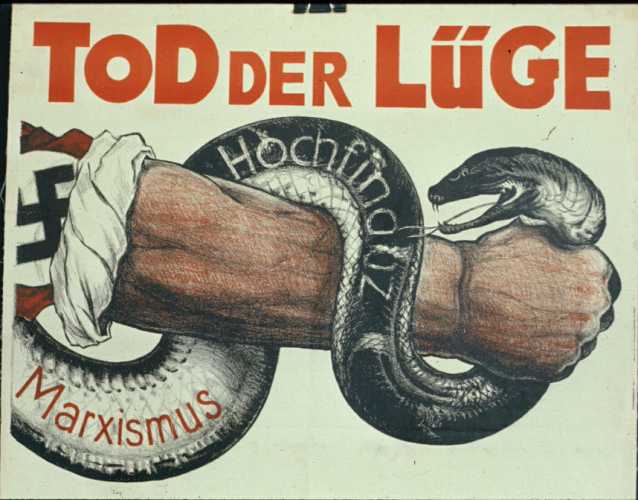
never a good time to be a German in finance

1931 political poster by the Nazi Party:
Death to lies: Marxism, High Finance

2009 political poster by the Social Democratic Party:
Financial sharks would vote for the Free Democrats