Last year, the World Bank called Georgia the world's "top economic reformer".
Foreign Direct Investment was 19.8% of Georgian GDP in 2007 (the highest rate in the world according to Richard Holbrooke) compared with 13.9% in 2006. In terms of raw amounts, FDI doubled every year.
In just three years, Georgia rose from 122nd to 18th — ahead of Germany — in the World Bank's "Doing Business" survey.
GDP grew an astounding 12.4% in 2007, one of the fastest rates in the world.
Just last month, Roy Southworth, World Bank country director for Georgia, praised Saakashvili's government for promoting growth, reducing poverty and fighting corruption.
Showing posts with label caucasus. Show all posts
Showing posts with label caucasus. Show all posts
Friday, August 22, 2008

Sunday, August 17, 2008
BBC bias part III
In another Reynolds piece,
It has been explained! See Deutsche Welle's interview with legal experts and note the "Not Another Kosovo" section. See also the New York Times on the question of "Is This Different Than Kosovo?" and this Slate piece: South Ossetia Isn't Kosovo. Reynolds' journalism is misleading because it implies that material like this does not exist. Responsible journalism would acknowledge the offered explanations and then bat them down in a piece that is clearly labeled opinion or editorial. Bonus question for Reynolds: when Russia "helped" South Ossetia did it help the more than 15 thousand Georgians living in South Ossetia who were robbed and expelled as a consequence of the Russian "help" or do they not count?
Since I've titled this "BBC bias" instead of "Paul Reynolds bias", let's consider a BBC piece without an author byline. The "timeline" pulls a Georgian action on August 7 out of the sequence of events to mark its beginning, the day "Georgian forces launch a surprise attack".
"Surprise"! From out of the clear blue sky of peace and harmony "perfidious" Georgian aggression bursts forth! Yet Russia's Interfax news agency reported that on August 5 "Volunteers are arriving in South Ossetia to offer help in the event of Georgian aggression". You've got forces moving across the internationally recognized Russia/Georgia border and that's just ignored?
According to the UK Times,
And according to the New York Times,
Perhaps someone will write "surprise" on a piece of paper and pin it next to Reynold's "evidence" on a bulletin board in the BBC editorial room under the title of "We Called It!".
Meanwhile, the UK Times reports what went on behind Russian lines, as does the Guardian.

UPDATE (August 24): A BBC Editor has apologized... for a "slip" whereby a "Russian invasion" was mentioned. There was no invasion. So very sorry. The Russian army ended up in Poti on the BBC's magic carpet ride, also known as a "humanitarian intervention". The there was no US-led "humanitarian intervention" in Iraq, however, the BBC can call an "invasion" when it sees one!
... the West needs to acknowledge that the Russians did have a case. It needs to explain why it helped Kosovo but questioned Russia's right to help South Ossetia
It has been explained! See Deutsche Welle's interview with legal experts and note the "Not Another Kosovo" section. See also the New York Times on the question of "Is This Different Than Kosovo?" and this Slate piece: South Ossetia Isn't Kosovo. Reynolds' journalism is misleading because it implies that material like this does not exist. Responsible journalism would acknowledge the offered explanations and then bat them down in a piece that is clearly labeled opinion or editorial. Bonus question for Reynolds: when Russia "helped" South Ossetia did it help the more than 15 thousand Georgians living in South Ossetia who were robbed and expelled as a consequence of the Russian "help" or do they not count?
Since I've titled this "BBC bias" instead of "Paul Reynolds bias", let's consider a BBC piece without an author byline. The "timeline" pulls a Georgian action on August 7 out of the sequence of events to mark its beginning, the day "Georgian forces launch a surprise attack".
"Surprise"! From out of the clear blue sky of peace and harmony "perfidious" Georgian aggression bursts forth! Yet Russia's Interfax news agency reported that on August 5 "Volunteers are arriving in South Ossetia to offer help in the event of Georgian aggression". You've got forces moving across the internationally recognized Russia/Georgia border and that's just ignored?
According to the UK Times,
[t]he US State Department’s internal timeline of the crisis pinpoints the explosion on August 1 of two roadside bombs, believed to have been planted by South Ossetian separatists sympathetic to Russia, as a decisive moment. Five Georgian policemen were injured, one severely. ... It now appears that August 1 was a well-prepared “provocation”...
And according to the New York Times,
Pentagon and military officials say Russia held a major ground exercise in July just north of Georgia’s border, called Caucasus 2008, that played out a chain of events like the one carried out over recent days.
'This exercise was exactly what they executed in Georgia just a few weeks later,' said Dale Herspring, an expert on Russian military affairs at Kansas State University. 'This exercise was a complete dress rehearsal.'
Perhaps someone will write "surprise" on a piece of paper and pin it next to Reynold's "evidence" on a bulletin board in the BBC editorial room under the title of "We Called It!".
Meanwhile, the UK Times reports what went on behind Russian lines, as does the Guardian.
UPDATE (August 24): A BBC Editor has apologized... for a "slip" whereby a "Russian invasion" was mentioned. There was no invasion. So very sorry. The Russian army ended up in Poti on the BBC's magic carpet ride, also known as a "humanitarian intervention". The there was no US-led "humanitarian intervention" in Iraq, however, the BBC can call an "invasion" when it sees one!
BBC bias part II
The examples of BBC partiality don't end there, although the further examples are not nearly as egregious as what I noted yesterday; that is, Reynold's description of Ossetian allegations as "evidence" (South Ossetia also claims that "Georgian fascists' atrocities ... outshone those of World War II Nazis"; - is that "evidence" as well, Mr Reynolds, that doesn't need a "difficult to verify" tag like Georgian claims?) and his painting of Moscow as the victim in "propaganda war" and/or "mud" slinging "media game" that Reynolds furthermore suggests is masterminded by "[t]he Bush administration". As Human Rights Watch noted, this was no "game" for victims here.
To consider another, less outrageous, example, then, take this Reynold's article:
By that logic it would "not be hard for Russia to justify" an invasion of any and all of the Baltic States and Ukraine!
Justify to whom? To us? To the BBC? Titling the section "Do not allow a cuckoo to police the nest" is not a substitute for "justify TO ITSELF" if that's all Reynolds means to say. Failing to add "to itself" is the sort of editorial lapse I'm talking about here; minor, but real enough to take issue with - I'm not saying the BBC is no better than Russia Today.
More importantly, is there any "argument" "against that"? Is there an acknowledgment of the remarks of the current Chair of the Committee of Ministers of the Council of Europe, Sweden's Carl Bildt:
No. Instead, in the same piece, Reynolds writes of
To consider another, less outrageous, example, then, take this Reynold's article:
It was not hard for Russia to justify its intervention. It simply stated that its citizens were not only at risk but under attack.
By that logic it would "not be hard for Russia to justify" an invasion of any and all of the Baltic States and Ukraine!
Justify to whom? To us? To the BBC? Titling the section "Do not allow a cuckoo to police the nest" is not a substitute for "justify TO ITSELF" if that's all Reynolds means to say. Failing to add "to itself" is the sort of editorial lapse I'm talking about here; minor, but real enough to take issue with - I'm not saying the BBC is no better than Russia Today.
More importantly, is there any "argument" "against that"? Is there an acknowledgment of the remarks of the current Chair of the Committee of Ministers of the Council of Europe, Sweden's Carl Bildt:
We did not accept military intervention by Milosevic's Serbia in other former Yugoslav states on the grounds of protecting Serbian passport holders. And we have reason to remember how Hitler used this very doctrine little more than half a century ago to undermine and attack substantial parts of central Europe
No. Instead, in the same piece, Reynolds writes of
the neo-conservatives ... who see Georgia (and Ukraine) as flag bearers for freedom which must be supported... Against that is the argument...Reynolds doesn't miss the chance to inform readers of a counter-argument to "neo-con" appeals to "freedom" but treats Russia's self-interested casus belli uncritically. That isn't bias?
Saturday, August 16, 2008
BBC bias on display: unverified vs "evidence"
While the BBC qualifies the claims of Georgian refugees as unverified ("but..."), the claims of Ossetian refugees are "evidence"! BBC correspondent Paul Reynolds also takes a select quote from Human Rights Watch to argue, in a non sequitur stretching from Tskhinvali to the White House, that "[t]he Bush administration appears to be ... playing down the Georgian attack [into the parts of its breakaway enclave that it does not already control] on 7 August". Never mind that Tom Parfitt of the Guardian quotes Human Rights Watch's Anna Neistat as saying
The "machine" even managed to get "2000 dead" out on FOX, practically the citadel of conservative American mass media, from where it's gone viral on youtube and is raging through the blogosphere like Ossetians through Georgian villages. Yet Reynolds reports the "news" that Russia "los[t] the propaganda war"!
I suppose BBC's abandonment of its MSM gatekeeper role concerning the Ossetian/Russian allegations is a fitting parallel to the role the west has played concerning the gates to Georgia.
While Reynolds takes Georgia's relatively fledgling communications to task for daring to draw analogies with Prague in 1968 or Budapest in 1956 ("The comparisons did not fit the facts"), the International Herald Tribune ("the global edition of the New York Times") says that today "Russian armor ... travel[ed] nearly to the edge of the Georgian capital", a move that "opened a new security vacuum between Gori and [Igoeti], creating fresh targets" for "looters and armed gangs in uniform - many of them apparently Ossetians, Chechens and Cossacks - [who] have operated behind the army's path, ransacking villages..." and in another article titled "Georgians doing forced labor in South Ossetia" the paper quotes "a Russian officer" as believing that "Labor even turns monkeys into humans."
Reynolds also wags the finger at the "Western media" and unspecified nefarious forces for throwing "mud" at Moscow, and the BBC does not identify this piece as opinion or editorial?
I've e-mailed Mr Reynolds to ask him to comment on the rather different perspective of the editors at the Washington Post.
After reading this gripping overview in the Guardian, "A dirty little war", I don't think it is too much to say, shame on you, BBC, not just for being biased (to the anti-American left), but for abandoning the humanitarianism of left-leaning journalism like that of the Guardian. Guardian op-eds and editorials have "Comment" above their titles. This one has "News". The paper is accordingly puting the full weight of its credibility behind the claims of the fact this piece, claims of fact Reynolds should be challenging if he is not going to be writing a retraction.
"The torching of houses in these [Georgian] villages is in some ways a result of the massive Russian propaganda machine which constantly repeats claims of genocide and exaggerates the casualties. That is then used to justify retribution."
The "machine" even managed to get "2000 dead" out on FOX, practically the citadel of conservative American mass media, from where it's gone viral on youtube and is raging through the blogosphere like Ossetians through Georgian villages. Yet Reynolds reports the "news" that Russia "los[t] the propaganda war"!
I suppose BBC's abandonment of its MSM gatekeeper role concerning the Ossetian/Russian allegations is a fitting parallel to the role the west has played concerning the gates to Georgia.
While Reynolds takes Georgia's relatively fledgling communications to task for daring to draw analogies with Prague in 1968 or Budapest in 1956 ("The comparisons did not fit the facts"), the International Herald Tribune ("the global edition of the New York Times") says that today "Russian armor ... travel[ed] nearly to the edge of the Georgian capital", a move that "opened a new security vacuum between Gori and [Igoeti], creating fresh targets" for "looters and armed gangs in uniform - many of them apparently Ossetians, Chechens and Cossacks - [who] have operated behind the army's path, ransacking villages..." and in another article titled "Georgians doing forced labor in South Ossetia" the paper quotes "a Russian officer" as believing that "Labor even turns monkeys into humans."
Reynolds also wags the finger at the "Western media" and unspecified nefarious forces for throwing "mud" at Moscow, and the BBC does not identify this piece as opinion or editorial?
I've e-mailed Mr Reynolds to ask him to comment on the rather different perspective of the editors at the Washington Post.
After reading this gripping overview in the Guardian, "A dirty little war", I don't think it is too much to say, shame on you, BBC, not just for being biased (to the anti-American left), but for abandoning the humanitarianism of left-leaning journalism like that of the Guardian. Guardian op-eds and editorials have "Comment" above their titles. This one has "News". The paper is accordingly puting the full weight of its credibility behind the claims of the fact this piece, claims of fact Reynolds should be challenging if he is not going to be writing a retraction.
Friday, August 15, 2008
some disturbing videos
Turkish journalists under fire. See here for the rest of the story.
This FOX clip appears to be going viral. Watch it and draw your own conclusions about whether anyone is being censored.
Notice that the FOX host started stuttering a bit after the "2000 were killed" claim. No doubt it created a real dilemma for FOX given the following:
Excellent op-eds here and here.
This FOX clip appears to be going viral. Watch it and draw your own conclusions about whether anyone is being censored.
Notice that the FOX host started stuttering a bit after the "2000 were killed" claim. No doubt it created a real dilemma for FOX given the following:
The torching of houses in these villages is in some ways a result of the massive Russia propaganda machine which constantly repeats claims of genocide and exaggerates the casualties. That is then used to justify retribution.See also this Wall Street Journal article, "Evidence in Georgia Belies Russia's Claims of 'Genocide'"
- Anna Neistat of Human Rights Watch
Excellent op-eds here and here.
Wednesday, August 13, 2008
"an orgy of looting, burning, murdering and rape"
See this story and this one. Those familiar with what happened to East Prussia in 1945 would know that it's not the first line of Russian soldiers that are the humanitarian problem so much as the secondary line of not-so-Russians.
Meanwhile, Human Rights Watch, a group that is also pro-abortion, anti-capital punishment, and pro-gay rights, says that a "massive Russia propaganda machine" is at work here.
Meanwhile, Human Rights Watch, a group that is also pro-abortion, anti-capital punishment, and pro-gay rights, says that a "massive Russia propaganda machine" is at work here.
Tuesday, August 12, 2008
ex-Republics regress towards failed states
The Reuters story "Moldovan separatists break off talks over Georgia" doesn't surprise me. Having driven the separatist thorn deeper into Georgia's side, Moscow has sent a message to the rest of its former republics.
What's frustrating for me is the way people equivocate between Slobodan Milosevic's Serbia and the Georgia of the Rose Revolution. All separatists were not created equal, nor all countries with separatist enclaves. I've been to Transdniester, and it is the most corrupt "country" of the 50+ I've travelled in the last four years. It combines smuggling and gangsterism with Soviet nostalgia. When I exited Moldova into Romania, the Moldovan border guards were professional and honest. Yet they will never be part of an EU country so long they can't get a grip on their eastern border. It suits Moscow perfectly fine if the ex-republics remain plagued by unresolved conflicts.
Although I never entered South Ossetia while I was in Georgia, I find it entirely plausible that it's a hornet's nest of crime and smuggling with thugs as its nominal leaders. However sympathetic one might be inclined to be to the Ossetians in theory, from my experience of Georgians and Russians or Russian allies like Transdniester, I find it preposterous to suggest that the 20 000 ethnic Georgians in South Ossetia would have their human rights better protected by Putin or Putin supporters than the 50 000 ethnic Ossetians would have their human rights protected by Saakashvili. The New York Times reports that Hillary Clinton signed McCain's letter nominating the young Georgian President for the 2005 Nobel Peace Prize.
This is not to say that the Georgians struck me as southern Finns. I didn't see the mentality one finds in a western democracy at every turn. But what I did see were developing cultural norms that are the critical enablers of progress towards that goal, and in light of that I believe due allowance should be made for any exaggerating that may have occured in the communications of the Georgian government this past week. Are the Estonians, Latvians, and Lithuanians sympathetic to small ethnic groups? Of course they are. But they know what the real deal is here, and accordingly don't project onto the South Ossetians some sort of liberal self-determination thesis that does not square with the facts on the ground. Anyone who is familiar with what happens in wars would not be the least bit surprised if the Ossetians are getting their vengeance while I write on the Georgians in South Ossetia who are no longer protected by the Georgian government.
Whatever the faults of the Georgians, Moscow is running an extremely sophisticated propaganda operation with respect to colouring how the world sees them, and suggesting people try to look through that is not to say that they are somehow angels next to Russian demons. It's rather to say that there is no real substitute to actually going to the region and drawing one's own conclusions.
NATO and the EU do not invite just any tinpot dictatorship or banana republic to join their club. On the contrary, they have standards. What the White House proposed in Bucharest was extending a "map" towards membership to Georgia. This "map" largely coincides with political and economic progress, but a great many people seem to think that the fact the derailer of this process is a foil to the USA is all the reason they need to cheer the result.
The colour revolutions stumbled this week on the rocks Moscow threw in front of them and I find it a very regrettable development in the human journey towards prosperity and freedom of expression.
See this New York Times link for some excellent backgrounders.
What's frustrating for me is the way people equivocate between Slobodan Milosevic's Serbia and the Georgia of the Rose Revolution. All separatists were not created equal, nor all countries with separatist enclaves. I've been to Transdniester, and it is the most corrupt "country" of the 50+ I've travelled in the last four years. It combines smuggling and gangsterism with Soviet nostalgia. When I exited Moldova into Romania, the Moldovan border guards were professional and honest. Yet they will never be part of an EU country so long they can't get a grip on their eastern border. It suits Moscow perfectly fine if the ex-republics remain plagued by unresolved conflicts.
Although I never entered South Ossetia while I was in Georgia, I find it entirely plausible that it's a hornet's nest of crime and smuggling with thugs as its nominal leaders. However sympathetic one might be inclined to be to the Ossetians in theory, from my experience of Georgians and Russians or Russian allies like Transdniester, I find it preposterous to suggest that the 20 000 ethnic Georgians in South Ossetia would have their human rights better protected by Putin or Putin supporters than the 50 000 ethnic Ossetians would have their human rights protected by Saakashvili. The New York Times reports that Hillary Clinton signed McCain's letter nominating the young Georgian President for the 2005 Nobel Peace Prize.
This is not to say that the Georgians struck me as southern Finns. I didn't see the mentality one finds in a western democracy at every turn. But what I did see were developing cultural norms that are the critical enablers of progress towards that goal, and in light of that I believe due allowance should be made for any exaggerating that may have occured in the communications of the Georgian government this past week. Are the Estonians, Latvians, and Lithuanians sympathetic to small ethnic groups? Of course they are. But they know what the real deal is here, and accordingly don't project onto the South Ossetians some sort of liberal self-determination thesis that does not square with the facts on the ground. Anyone who is familiar with what happens in wars would not be the least bit surprised if the Ossetians are getting their vengeance while I write on the Georgians in South Ossetia who are no longer protected by the Georgian government.
Whatever the faults of the Georgians, Moscow is running an extremely sophisticated propaganda operation with respect to colouring how the world sees them, and suggesting people try to look through that is not to say that they are somehow angels next to Russian demons. It's rather to say that there is no real substitute to actually going to the region and drawing one's own conclusions.
NATO and the EU do not invite just any tinpot dictatorship or banana republic to join their club. On the contrary, they have standards. What the White House proposed in Bucharest was extending a "map" towards membership to Georgia. This "map" largely coincides with political and economic progress, but a great many people seem to think that the fact the derailer of this process is a foil to the USA is all the reason they need to cheer the result.
The colour revolutions stumbled this week on the rocks Moscow threw in front of them and I find it a very regrettable development in the human journey towards prosperity and freedom of expression.
See this New York Times link for some excellent backgrounders.
"gonna keep on rollin', baby"
to quote Fred Durst...
"Attacks on Georgia continue despite Russian president's calls to halt"
and
"Russians shells Gori despite claims Georgia conflict is over"
Meanwhile, on the coast:
I ended up spending a couple days in Poti last fall, because I was trying to get on a freighter to the Ukraine and its departure kept getting delayed.
"Attacks on Georgia continue despite Russian president's calls to halt"
and
"Russians shells Gori despite claims Georgia conflict is over"
Meanwhile, on the coast:
In Poti, a port city in western Georgia, a New York Times correspondent heard bombs falling ...
Residents and officials were tense as Russian troops drove through the city, talking to residents. They appeared to be digging into positions on the city’s outskirts. There were reports that Russian troops were engaged in similar activities in the western Georgian towns of Zugdidi and Kareli, an American official said.
About four miles outside Poti, a dozen armored vehicles guarded a bridge and the road onwards to Batumi, another Black Sea port. The troops, who spoke Russian and wore patches indicating they were paratroopers, said they were peacekeepers.
I ended up spending a couple days in Poti last fall, because I was trying to get on a freighter to the Ukraine and its departure kept getting delayed.
Monday, August 11, 2008
DailyKos blogger denounces Moscow
This DailyKos post is a remarkable illustration of how elements of the US left have decided to adopt McCain's position of supporting the Baltics' view of the Georgia situation. The post calls attention to the wire story "Russia Warns Baltics, Poland To Pay For Georgia Stance".
The position of the Baltic State Presidents evidently reflects the popular will, given the demonstrations there.
Meanwhile, the Moscow rebuffs the French.
Russia Today reportedly hired a westerner named William Dunbar to report for them, but refused to broadcast his reporting because it didn't serve the Kremlin's propaganda line. According to Dunbar,
Abkhazia is more strategically vital than South Ossetia. The Georgians made no moves towards Abkhazia yet the Russian buildup there has been significant and Russian "peacekeepers" advanced as far beyond Abkhazia as Senaki, which cut the rail connection between the Georgian capital and the coast. What really matters to Moscow here is derailing any progress towards an internationally mediated settlement in Abkhazia. If the Georgians understood that they would have retreated west from South Ossetia towards Abkhazia as opposed to east towards Tbilisi. A Russian drive on Tbilisi was always unlikely because the world community would be unlikely to tolerate an unlimited war of conquest, but Georgian paranoia infected their communications to the point that their credibility is somewhat damaged. The next time they cry, "the Russians are coming!" the western media will suspect the Georgians are exaggerating.
The position of the Baltic State Presidents evidently reflects the popular will, given the demonstrations there.
Meanwhile, the Moscow rebuffs the French.
Russia Today reportedly hired a westerner named William Dunbar to report for them, but refused to broadcast his reporting because it didn't serve the Kremlin's propaganda line. According to Dunbar,
I felt that I had no choice but to resign. I had a series of live, video satellite links scheduled for later that day, and they were cancelled. The real news, the real facts of the matter, didn't conform to what they were trying to report, and therefore, they wouldn't let me report it.
Abkhazia is more strategically vital than South Ossetia. The Georgians made no moves towards Abkhazia yet the Russian buildup there has been significant and Russian "peacekeepers" advanced as far beyond Abkhazia as Senaki, which cut the rail connection between the Georgian capital and the coast. What really matters to Moscow here is derailing any progress towards an internationally mediated settlement in Abkhazia. If the Georgians understood that they would have retreated west from South Ossetia towards Abkhazia as opposed to east towards Tbilisi. A Russian drive on Tbilisi was always unlikely because the world community would be unlikely to tolerate an unlimited war of conquest, but Georgian paranoia infected their communications to the point that their credibility is somewhat damaged. The next time they cry, "the Russians are coming!" the western media will suspect the Georgians are exaggerating.
I'm a little disappointed...
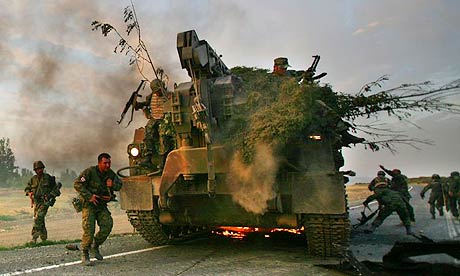
in the Georgian military performance so far. According the Guardian, the attached photo is "on the road to Tbilisi".
The UK Telegraph says "Georgians were witnessed by the Telegraph in a full scale disorganised and panicked retreat from Gori." I hope that's Georgian civilians, but given reports that the Russians overran Senaki, which on the main rail line between the Georgian capital and the coast (I took an overnight train through Senaki from Tbilisi last October), it sounds like it could be the Georgian military that's in full retreat. The Associated Press says one of their film crews "saw Georgian tanks and military vehicles speeding along the road from Gori to Tbilisi. Firing began and people ran for cover. Cars could be seen in flames along the side of the road."
I took a day trip to Gori while I was in the country last autumn and I'm sorry to hear that the Russians bombed it and sorrier still to think that the Georgians may have abandoned it without much of a fight. That said, I can appreciate the importance to trying to set up a defensive line around the capital. I just think it is something of a propaganda coup for the Russians if they can go on the rampage in the rest of the country, destroy everything, and then pull back saying they are peace lovers because they didn't bear down on the capital.

Subscribe to:
Posts (Atom)
