Saturday, October 31, 2009

if I run for office I never wrote this

Your plucky pundit was laid low this past week by an unkind flu virus. Was it H1N1? I don't know, although it fit the symptoms. I'd recommend that everyone get the shot, if only to avoid doing something imprudent when at the height of the fever, like blogging about a dangerous topic.

I had been thinking about commenting on Ian Robinson's Calgary Sun column "Right wing women rock", which exhorts the discerning political analyst to "look at the shoes", but thought better of it, since I already got myself into trouble over @ daveberta by making the sexist insinuation that if the Calgary Board of Education of a decade ago weren't all female, we might have been deprived of the drama of board members writing "nasty notes" to each other regarding the hairdos and outfits of their fellow Trustees.
In my defence I insisted that I was refraining from judgement, since, after all, I wasn't there to assess whether the crime against fashion was on the level of mere misdemeanor or was rather grievous felony such that an appropriately snarky response or two might have been entirely called for. What was it that Edmund Burke said, "all it takes for bad taste to triumph is for good [wo?]men to say nothing," or something like that? So I'll just stop right there. Well, OK, maybe I won't; - I have to question Robinson's conclusion:
We've got Elisabeth Hasselbeck.
Checkmate.
Might this wrongly imply that there is just one trump card in the deck? Although Mrs Hasselbeck does a redoubtable job of sporting a McCain T (above left), perhaps Meghan McCain (right), who occasionally subs for Hasselbeck on the View, would also be up to the task? I'll certainly grant she may be altogether too libertarian, but how can Twittering under "-ette" not be seen as righteously defiant femininity?
@McCainBlogette: I love being a woman. I love being a Republican. I am incredibly in touch with both of these things. Neither is going to change
If that isn't unchange you can believe in, what is? Ms McCain tells us what we all want to know:
@McCainBlogette: my shoes are steve madden, my nail polish is essie punchy pink for those that asked
Given her use of the plural here ("those") I wasn't alone in my inquiries!

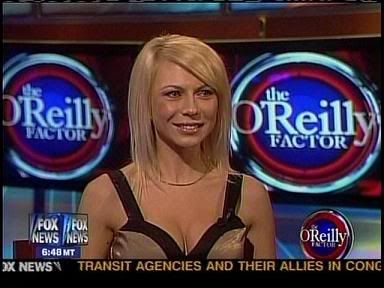
Too girly-girl? How about geeky-girl? Consider everyone's favourite fox on FOX, Marina Orlova (left). Someone might object that just because she appears on Bill O'Reilly's show that doesn't mean she's a right winger, but I'd point out that she's a Russian philologist, and do you know of a Russian philologist who leans left? Checkmate.

Sunday, October 25, 2009

conservative fiscal policy and meaning it

While the greatest dangers of the financial crisis may no longer be acute, chronic fiscal challenges remain for most western democracies. Demographic change in particular means that higher levels of saving and investment, both publicly and privately, are necessary if standards of living are going to continue to improve.

What are the options for ensuring this?

The #1 priority in my view is continuing with tax reforms which have been occurring in most jurisdictions (Alberta not being one of them) that encourage the shifting of income from consumption to savings and investment. Even if governments were to start diverting massive amounts of their tax revenue away from consumption by holding the line on services and building up financial and physical assets, tax revenue is only a fraction of a jurisdiction's total public and private income and the private sector's contribution, or lack thereof, to the capital stock, whether it be financial or be physical (property, planet, and equipment) has more impact.

But leaving aside further discussion of these tax reforms for another day and restricting our analysis to the income going to government, how can concerned citizens ensure that their governments are going to be genuinely conservative with the resources allotted to them? Although balanced budget legislation is a possibility and is the first proposal I will review, it is but one of many.

Balanced budget legislation

The two basic drawbacks to "no deficits" legislation are the same two problems we will encounter with a lot of proposals, and that is that 1) the policy deals with a flow instead of a stock and 2) governments can and do ignore such legislation. re point (1), a balanced budget requirement can help in that it sets a target minimum contribution to the stock of capital over a period, namely that it be non-negative (zero or higher). But there is nothing inherently problematic with a negative contribution (withdrawal) from the capital stock over some short period since that does not necessarily mean that the total contributions to and growth of the capital stock over the long term will not be superior to some other jurisdiction which makes a null or a positive contribution over every period. Nonetheless, even if the red/black distinction is ultimately an arbitrary accounting measure, it is still an occasional target, and as the Nudge book I mentioned in an earlier post points out, targets have value. The book's authors note how public urination facilities became a lot less messy when users where given something to aim for. Indeed, one could note that Alberta's current fiscal mess started when government revenues cycled upward and former Alberta premier Ralph Klein lost his target.

Legislation that limits government spending to inflation plus population growth

Again, this would set a target for a periodic flow instead of for the stock that actually matters, but it is a superior target to the balanced budget target since it does not mandate cuts at the worse possible time (during a recession) and mandates less spending proportionate to the economy at the best possible time (when the economy is growing quickly). In an interview with the Canadian Taxpayers Federation in September, then Wildrose Alliance leadership candidate Danielle Smith supported this target but added a proviso that spending also not exceed GDP growth. While this response had the virtues of garnering an A+ grade from the CTF and ensuring that the size of government shrinks relative to the economy not only when real GDP per capita is growing but also when it it shrinking, most economists would consider this additional restriction a mistake. The proviso ultimately undoes the advantage over the balanced budget target by being pro-cyclical: forcing government spending cuts when the economy is shrinking. While left leaning economists like Paul Krugman were demanding massive stimulus spending earlier this year, centrist organizations like the OECD were also urging national governments to pass large stimulus packages, and conservative economists like Greg Mankiw were not opposing the stimulus spending per se but rather acting as the voice for skepticism about how effective the particular proposed stimulus expenditures would be. It was generally recognized that "inaction on sound stimulus is indeed harmful." In almost no case was any prominent economist calling for prompt cuts to government spending. As another writer for the Economist notes, "Faced with growing demands on unemployment assistance, [when] states are forced to cut spending elsewhere... this is procyclical behaviour, which may act to increase unemployment further, forcing additional budget cuts, and so on." When one sets aside ideology for evidence based policy, the evidence from the Great Depression suggests that cutting back government expenditure at the same time that consumer expenditure is in decline creates the grave risk of an economic death spiral. Adding the GDP proviso is unnecessary, because when real GDP per capita growth (GDP growth less inflation and population growth) is negative that is by definition temporary (if real GDP per capita is in permanent decline the whole point of economics would be defeated). In other words, the size of government is also a stock, such that whether it is shrunk in every accounting time period is not ultimately germane to the real objective. Real GDP per capita will increase over the long term, meaning that over the long term the size of government relative to the economy will be reduced without adding a further constraining proviso to the inflation + population growth limit. I would also argue that the GDP deflator should be used in the place of "inflation" (I've equated the two in my discussion here) but that's a technical objection.

Legislation that requires a proportion of revenues (often a subset such as supposedly "non-core" revenues, e.g. natural resource royalties) be saved or invested

This target is part way between the above two targets, since while it shares with the inflation + population growth limit the advantage of not requiring cuts during a recession, under this target both spending and saving would grow in lockstep during boom times without an upper limit such that spending growth could still be very high. Again, when at economy is peaking an expansionary fiscal policy just encourages increased prices, and the increase in government purchases shifts resources away the private sector, a phenomenon known as "crowding out."

Combining a capital stock associated limit on spending (excluding infrastructure spending) with mandated revenue hedging

This proposal is my favourite since it has what I believe is an enormous advantage over the other proposals, namely, that governments will not be able to ignore the target because they simply will not have the money to violate the target. In the Alberta of 2007, for example, the government's positions in currency and energy futures would have been marked to market and the government thereby required to plow its windfall royalty income into international hedging markets. In 2009, we would see billions coming back to the province from these same markets. I would exclude infrastructure spending since this constitutes physical investment. While it is possible to invest poorly, and indeed the Alberta government has a consistent pattern of buying high and selling low by choosing to "buy" infrastructure assets when the market is at a top, it is still investment, and by mandating hedging the government's discretion to "buy high" will limited. Stock associated limits to spending could be akin to the covenants that bondholders demand from issuing corporations with respect to the health of their balance sheets as opposed to just their income sheets, or they could be the sort of constraints relatively sophisticated regulators apply to financial institutions (see Basel II), e.g. limits informed by Value at Risk modeling.

"Stock" associated limits to spending discretion may prove too complex to constitute a political campaign plank relative to a readily understandable limit like no more than inflation plus population growth, but hedging, while complex to explain in detail, is quite straightforward as a concept and the general idea that the citizens of Alberta are bondholders and shareholders in their government is also a fairly simple one. Should a politician's pay be tied to the size of the Heritage Fund à la a private sector executive's? The corporate analogy is worthy of consideration, not least because it could ensure more professional and competitiveness-oriented management.

I believe that this is THE challenge of our age. Do we leave something behind for the next generation or not? If we are serious we will not just talk about how we intend to start showing some willpower with respect to the cookie jar, we will explain how it will be placed outside of our reach.

UPDATE October 26:

The Wall St Journal notes that after posting a $1.4 trillion deficit in 2009, the US House of Representatives is now moving on spending bills that would grow domestic programs by a further 12.1% in 2010. The WSJ also observes that "real family incomes fell by 3.6% last year" and the point I wished to make about spending growth that is higher than GDP growth but no higher than inflation plus population growth is that this would or could maintain government services for consumers whose real incomes are falling. Although government would grow relative to the economy during this period of decline, there would no increase in real government services per person and the proportionate growth in government would be temporary. If government services are to be cut back as opposed to just kept from growing further, they should be cut back when real incomes are rising.

But I may have been imprudent to take issue with Danielle Smith in this context. As Don Martin observes in a revealing National Post column, "Ms. Smith was on an Ottawa talk show with me this week and, even though it was still pre-dawn darkness in Calgary, she batted every question out of the park..." The contrast with Sarah Palin being interviewed by Katie Couric (to take one of the most infamous episodes) could not be sharper. The takeaway fact with her is that she is one of the sharpest policy minds in politics, yet getting that most elementary of messages through the North American noise machine will be enough of a challenge without bothering with nuance. This morning Danielle ended up on the website of the Charleston (South Carolina) Daily Mail as "the Sarah Palin of Canada." How does this end up in the mainstream media? The Charleston Daily Mail writer uses the Canadian media as cover:
I figure the Canwest News Service knows something about Canada and the news service has declared Danielle Smith, the new leader of Alberta’s Wildrose Alliance, the Sarah Palin of Canada.
In fact the Vancouver Province writer who is cited here put a big question mark at the end of its "A Sarah Palin for Canada" headline, not a period. But with respect to which MSM outlet surrendered its gatekeeper role to the commercial appeal of another "Sarah Palin" headline that would indeed be Canwest since it was their writer who made a story out of a blogpost by 22 year old Colorado Springs blogger Adam Brickley. The meme was then picked up by Global TV Edmonton and the Examiner.

Friday, October 23, 2009

Nick Griffin, White House vs FOX, and the Overton window

If I am characterizing Joe Overton correctly, when someone comes along on a radical politician's political flank to promote even more radical ideas, it is plausible that the politician is encouraging this because it makes his or her ideas look less radical in comparison. It could be an effort to mainstream political deviance by repositioning the public's perception of deviance; i.e., "shift the window."

While I have a lot of time for ideas that place a lot of emphasis on how the range of "acceptable" opinion effectively limits political choices (I've argued that greater consciousness about the background "choice architecture" is more genuinely emancipatory than more formal choices - i.e. ballot casting - within the same constrained architecture), I'm skeptical of the thesis that the emergence of new radicals who are more extreme that the old typically helps the old radicals. Why? Because the dominating factor is polarization: if a political fight develops between the new radicals and their ideological opposites, ordinary people that are close to one side or the other will slide over that extra bit take up the fight for the "team", even though the prominent voice on the team is more extreme than their own.

Yesterday, British National Party leader Nick Griffin, who in June was elected to the European Parliament despite attracting less than 10% of the vote because of proportional representation, appeared on BBC's Question Time amidst an unsurprising uproar outside the studio. If one looks around the net for viewer reaction, the proportion of Britons exhibiting sympathy for Griffin is far in excess of 10%. The fact of the matter is that people like me, who are conservative but consider Griffin an extremist, find it difficult to not step into the debate to observe that, for example, with Peter Hain demanding that Griffin be barred from Question Time, you've got someone who today is as establishment as they come (Secretary of State for Wales) insisting that someone is being too radical to be heard when Hain made his own early career out of being radical (photo below is of Hain from 1969). Give me my own freedom of speech while denying it to someone else on the grounds that it isn't mainstream enough?


Could I point out that Hain was right in the thick of a campaign finance scandal this past year? Of course I could, but the reality is that I wouldn't be doing my reputation for judicious moderation (such as it is) any good by stepping in front of an attack on Griffin.

I believe this is what the Obama administration has in mind in its blasts at FOX News. It is difficult for many reasonable conservatives who find Glenn Beck etc over the top to resist the temptation to defend FOX with respect to the latest incident; indeed, Ken Rudin, who directs campaign coverage for NPR, described the White House's behaviour as "Nixonesque", a characterization he ended up apologizing for. If someone who's career depends upon preserving a neutral point of view couldn't resist the impulse to take a blast at FOX's attacker, how is anyone who is at all conservative supposed to refrain from similar comment? The situation is win-win for both the White House and FOX, since polarizing Americans will force those in the middle out into their respective camps. Everyone between them loses.

What is the latest incident? A month ago I wrote:
Obama has taken issue with FOX before, but this time the White House has further hinted that only "outlets" inclined to treat the administration uncritically will be granted access, meaning FOX would be a news gatherer who should not expect "participation any time soon."
That suggestion of mine that FOX will be frozen out in terms of participation has come true more thoroughly than I expected. As the Reporters Committee for Freedom of the Press has observed: "the White House tried to exclude Fox News – alone among the five White House "pool" networks – from interviewing executive-pay czar Kenneth R. Feinberg on Thursday."

CNN, ABC, CBS, and NBC (which all have reputations for being more or less centrist while NPR is considered left by conservatives and MSNBC is now considered left by almost everyone) all refused to play along with the administration's attempt to squeeze out FOX. The networks agreed that either FOX could interview as well or none of them would. The administration is now faced with the prospect of having to contend that CNN, ABC, CBS, and NBC are biased against them or admit that forcing people to be "for us" or "against us" will backfire when the generally respected majority chooses the latter camp.

Thursday, October 22, 2009

more on Wildrose Alliance personnel appointments

I've been advised that Shawn Howard has been designated Director of Communications. Shawn is principal of Shawn Howard Communications and may be contacted at 403-850-0885. No one told me to tell the world this but I reckon y'all either should know or would figure it out eventually.

If I were the comms guy, my response to the video put together by the Alberta Liberals would perhaps be more nuanced than that of our party spokesman in that I would say that a challenge to be fiscally conservative in more than just name is entirely legitimate, but add that Danielle Smith has never shown the slightest inclination to waver in the face of such a challenge, in stark contrast to the P"C" Party's rule of this decade which has consisted of headlong retreat whenever forces staking claims on taxpayer resources are encountered. In the coming weeks you'll be finding me making the case here for policy moves which if adopted by the Wildrose Alliance would dispel doubts about the party's commitment to fiscal conservatism because they would create structural impediments to fiscal profligacy as opposed to just rhetorical.

In any case Shawn Howard is a current holder of public office, and accordingly knows how to win an election. This is the sort of candidate we need to run for the party provincially, especially in extremely winnable ridings like Airdrie - Chestermere. As part of his responsibilities on Airdrie City Council, Shawn has exhibited a concern for taxpayer value. He's also shown sensitivity for the interests of business, something that is well placed in the view of most economists but typically takes a lot of political courage since although the benefits of attracting business to a jurisdiction are very real, they typically benefit voters indirectly. Although I was a Mike Nickel supporter for Edmonton City Council, on occasion Mike's behavior did not whet one's appetite for more, something I don't believe can be readily said about Shawn's work for the City of Airdrie given his collaborative and judicious approach.

There may be some who say that the party has enough communications and media people at this point and that going forward we need more economists and business executives from fields other than energy lest the party end up more concerned about the sizzle than the steak or act as a Trojan Horse for a particular industry. OK, maybe just I am saying that. But like anything it is far more constructive to get active and move the party in the direction you want it to go than to complain about where people who are passionate enough to get involved are taking it.

We aren't going to be able to cover up the fact that the party's centre of gravity is currently closer to the south than the north and I don't think we want to. It's rather a manageable challenge and I'm sure Danielle is just as concerned about ensuring a balance as I am. Our problem in Edmonton is not discrimination but a shortage of volunteers in general and distinguished personnel in particular. We need to work together and perhaps start by electing someone like Shawn Howard in what will be the new Edmonton Ward 9 in a year's time. It currently appears that there will not be an incumbent running in this ward and it should be favourable territory for a candidate who is interested in ensuring Edmonton's taxpayers get value for their money. The new ward system puts Tony Caterina's re-election prospects into considerable doubt, which could create the situation whereby none of the 12 councilors would be known for being fiscally conservative. This neither serves the interests of Edmonton nor is it democratically representative. By getting involving in civic politics and by sounding out local business and community leaders for their possible involvement in the party we'll ensure that the capital region maintains its voice.

Stephen Carter chief of staff for Danielle Smith

In response to a query, Wildrose Alliance leader Danielle Smith has confirmed to me that Stephen Carter will be her chief of staff. This is another step in the professionalization of our party leadership. In a party of 12000+ members, Danielle will not be able to spend her time leading if we are all clamoring over each other to demand her time and attention. For Albertans who have not had the opportunity to meet Danielle directly, in my opinion her spatial awareness has made significant progress since June such that if you should choose to attend an event involving Danielle and approach within a metre of her she will be aware of you and will be interested in meeting you face to face as soon as she can appropriately break away from her current conversation and make your personal acquaintance.

For those of us who have already had our one-on-one interaction, I would advise contacting Stephen who, as someone with Danielle's full faith and confidence, will manage access to our leader with an eye to our mutual interest in a dynamic and successful political party. I would accordingly encourage both media and party workers interested in contacting Danielle to get in touch with Stephen who will do his absolute best to ensure that you are fit into Danielle's schedule as appropriate to the priorities of the party whom Danielle was elected to serve, and Albertans in general.

Stephen is Executive Producer of event planner Carter McRae, and is a veteran spokesman for not only the federal Progressive Conservatives (subsequently the Conservative Party) but for the provincial PC party. The Alberta PC Association has to its credit a number of highly capable campaign workers, and the Wildrose Alliance extends a warm welcome to each and every one of these accomplished individuals who have decided to join the party of Alberta's future.

In the summer of 2007 I carried a sign-up sheet around with me to collect the necessary signatures to register a brand new Wildrose Party of Alberta. What do those people I approached at weddings, etc think when they see "Wildrose" in the headlines now?

Tuesday, October 20, 2009

"carbon capture projects are madness"

From Jeffrey Simpson's latest Globe and Mail column:
Prime Minister Stephen Harper makes so many spending announcements, flying like Mary Poppins on speed around the country to distribute billions of dollars, that the news media have given up analyzing any of them.
For the heck of it, let's look back to last week, when Mr. Harper dropped into Edmonton to announce $343-million of federal money for a coal-fired TransAlta Corp. carbon-capture and storage (CCS) project. Simultaneously, Alberta Premier Ed Stelmach announced a contribution of $436-million, for a total investment of $774-million of taxpayers' cash.
That Harper-Stelmach announcement followed an earlier Ottawa-Alberta one for a coal-fired Shell carbon storage project. In that case, the combined federal and provincial contribution was $865-million. ...
Let's be generous and assume the two projects costing $1.6-billion do in fact bury 2.1 million tonnes of carbon dioxide, the most-prevalent gas contributing to global warming. Such a reduction would mean a per-tonne carbon-reduction cost of about $761 – staggeringly, wildly, mind-blowingly higher than any other conceivable measure designed to cut greenhouse-gas emissions. ...

While you, the Alberta taxpayer, pay C$761 per tonne of CO2 abatement, which is equivalent to 494 euros, the price per tonne in Europe has ranged between 10 and 30 euros year to date:


What has the reaction of the Stelmach government been to the Wildrose Alliance party, whose leader has denounced Stelmach's multibillion dollar carbon capture fund as a political boondoggle?
If they want to be relevant, they have to develop a long term policy strategy which speaks to a modern, compassionate, cosmopolitan Alberta and I don't think they do.
- Edmonton Whitemud MLA and Education Minister Dave Hancock
The P"C" party thus asks you to understand, dear Albertan, that you are spending billions on CO2 abatement that costs $761 a tonne because this is what "modern" and "cosmopolitan" jurisdictions do. In fact, if you looked up either word in the dictionary you would see the smiling faces of Premier Ed Stelmach, Finance Minister Iris Evans, and Energy Minister Mel Knight! Those euro types are a bunch of rubes who just fell off a turnip wagon compared to these public policy prodigies. And as for you young and unborn Albertans who will be coming of age in a jurisdiction that squandered the natural resource wealth it was once blessed with, well, that's how we, the Alberta P"C" Association, define "compassion." Now please take a seat while your august government gets back to the business of closing hospital beds and increasing class sizes!

Monday, October 19, 2009

"major policy announcement"?

I had to shudder a bit when the Calgary Herald reported this afternoon that newly minted Wildrose Alliance leader Danielle Smith had indicated this morning that "she'll make a major policy announcement in the coming weeks..."

I had visions of a "stage[d] message event and photo op" for some "catchy, highly-visible, easy-to-communicate" gimmick that would be most distinguished by how far it was from a serious, technical policy plank like, to take a contrasting example, "a decrease in the marginal rate of the third bracket in personal income tax." Again, my concern followed from the fact that my raison d'être for getting more politically involved was to oppose the dumbing down of the policy debate and get more of the technical debates that were occurring in places like government central agencies, academia, and think tanks into the mass market arena, not less.

While I have 99% confidence in Danielle herself on policy (the remaining 1% being held back at present because her ties to Calgary and Edmonton are in the process of being balanced as opposed to starting out that way, and there isn't an urban wonk like Mike Percy from the capital city who has her ear to my knowledge) some of my concern was, I think, well founded given that all of the quotes in the above paragraph are by someone who not only was the keynote speaker at the last Wildrose Alliance AGM but someone who has been mentioned in association with the party leader in a number of media reports. Another person who may have influence with Danielle once asked me about policies that would appeal to rural voters. I provided some names of those who worked in the field of rural economy at the U of A, but didn't really have much to say about a specific idea of his that would have involved a claim on the taxpayer. I did my MBA with a guy on the inside of the Alberta Agriculture and I could only shake my head at some of the boondoggles going on. "The reality is that the government knows that it is elected by rural voters," my fellow student would explain. If a fellow Wildrose Alliance candidate should then ask me how to out-boondoggle the Tories when it comes to rural Alberta what was I supposed to say?

But looking at what Danielle actually said it appears that I was being paranoid that a provincial version of Harper surrounded by 5% GST stickers would be coming down the pipe, or that some less gimmicky but no less airy announcement was in the works like a declaration that a certain component of provincial revenues will be dedicated to the Heritage Fund, which would be an easy lay-up precisely because there would be no acknowledgement of who would be the losers from such a move; indeed, the provincial Tories have had this plank for decades but just changed it or ignored it whenever there might actually be a loser (which was, of course, every time it actually mattered!) and would stand in contrast to a tax reform that would truly force a diversion of income coming to the private and/or public sectors away from current consumption and into an accumulating capital stock (typically, the easier the win in politics, the less that is won). She in fact said that "we will making a major policy address in November." An "address" could mean something about the procedure of policy development. Indeed, a few media sources say that that is exactly what is involved here.

Bottom line is that my understanding as reflected in my last post seems to be the correct one: some sort of convention or consultative roundtables are going to be announced.